When I was a teenager living in Asheville, downtown was empty. I can imagine tumbleweeds rolling down the streets. There was the bank where my father worked; the Civic Center; a single upscale restaurant, 23 Page; a few X-rated theaters that my mother forbade me to enter; and a whole bunch of office windows with “To Let” or “For Rent” signs in them.
If you have been to Asheville anytime over the past ten years, you know that now it looks more like this:

Asheville is now hopping with art galleries, restaurants, shops, breweries, wine bars, and festivals. That has its own problems, such as crowds and parking, but overall I’d much rather have downtown Asheville like this than have it remain the wasteland it was in the mid-to-late 1980s.
Malaprop’s was one of the first stores to usher in the new era. While it began in 1982 and developed a core following, it wasn’t until it moved to its current location in 1997 that it became one of the premier independent bookstores in the South, if not the United States. (You can read about its humble beginnings and goals here.)
My family moved to Atlanta in 1988, and while I have a vague memory of possibly going to Malaprop’s at its old location, I didn’t make a proper visit to its new location until well into the 21st century. I’d heard of it, of course. But the store is truly a delightful place. I’ve been a handful of times over the past few years, and each time feels a bit like a pilgrimage. It has the same sort of feng shui of most indie bookstores, striking a balance between crowded and comfortable–a sort of cozy atmosphere, where everywhere you turn there are books but there are also enough places where a customer can have a private moment alone with an old or new favorite book.
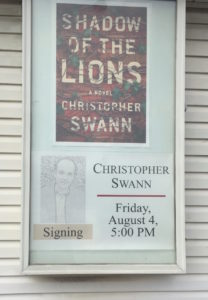
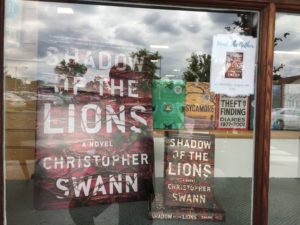
I’d been growing more excited about going to Malaprop’s as an actual author since two friends of mine, Claire and Quinton, posted this picture on Facebook on July 1 with the caption “Guess what we spotted in a bookstore window in Asheville tonight!!!”
This was the first time someone had spotted a notice about my book in an actual bookstore.
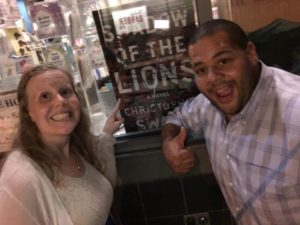
The night of my reading at Malaprop’s, I was joined by my wife Kathy, who had driven up from Atlanta, and our sons Whitaker and Sullivan, who had been spending the past two weeks with my parents in Asheville. We arrived at Malaprop’s about an hour ahead of time, which allowed us to get a picture of both boys with the sign outside of the store. 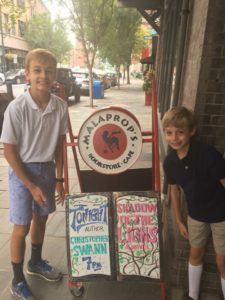 On setting foot inside the store, both boys began roaming the store, peering at shelves. Sullivan wanted the next book in Alan Gratz’s The League of Seven series. Whitaker was drawn to Malaprop’s “blind date” shelf of books wrapped in brown butcher paper. The staff writes a few choice adjectives for the wrapped book on the outside of the paper, and those are the only clues as to what kind of story is hidden beneath the paper. Whitaker carefully chose one, which turned out to be The Madman’s Daughter, a revisioning of H.G. Wells’ The Island of Doctor Moreau.
I was a little jealous, watching both boys. I wanted to wander around the bookstore and discover a new book. Instead, I was preparing to talk about my own book, with not a few butterflies in my stomach.
Understand that I’m not complaining. I’d been dreaming of writing a novel since I was in eighth grade. This was, quite literally, part of a lifelong dream coming true. But now I was going to do my dog-and-pony show in front of my parents and their friends, some of whom had known me since I was a teenager. And my throat was a little sore. That was all I needed, to lose my voice. Fortunately the café served a lemon-infused camomile tea that I dosed with honey, which did wonders.
Jacob, one of the store staff, was setting out about a dozen folding chairs. “Jacob,” Kathy said, shaking her head in mock disappointment, “we’re going to need a lot more chairs.”
I laughed, then felt the butterflies come back. How many people were going to come? Would the store be packed? Would no one come at all? Which would be worse?
Then my parents arrived, followed soon by my godparents Croom and Meriwether. Before I knew it, I was shaking hands with many more of my parents’ friends and introducing Kathy. Then a tall man hove into view with a familiar, easy smile. It was Kirk Duncan, my former head of school and now head of Carolina Day School in Asheville. Somehow seeing Kirk set me at ease.
Before I knew it, Jacob had me sitting on a stool at the front of the seated crowd–while the store wasn’t technically packed, it was a close thing–and adjusted a microphone on a stand so it hovered right in front of my mouth. Both Whitaker and Sullivan sat in the front row, while Kathy sat in the very back. Later she told me she stayed back because she thought I was nervous and would do better if she wasn’t sitting right up next to me. 
Jacob introduced me to a round of applause, and I began speaking. Despite years of teaching students, I still get nervous before addressing a group. The microphone had dipped perhaps half an inch, which led to me hunching over slightly as I spoke into it. At the back of the room, Kathy was gesturing with her hands, palms up toward the ceiling. I thought she was telling me to sit up, which I couldn’t do if I wanted to keep speaking into the microphone. She was instead telling me to speak louder.
I began reading the more dramatic passage from the prologue that I had read the night before in Charlotte. The audience was still, listening. Whitaker seemed to be listening pretty closely. Sullivan, meanwhile, was mostly reading from his own book. Occasionally he would turn around in his seat to find Kathy, sitting in the back, and he would wave at her or hold up his book to show her what he was doing. Kathy would gesture at him to turn around and pay attention to me. I found the whole thing funny.
Everyone clapped when I finished reading. They asked me a few polite questions. A few were grinning openly, clearly getting a kick out of seeing David and Nancy Swann’s son–an honest-to-God novelist!–giving a reading in Asheville. There was a pause in the questions, and then Kathy raised her hand in the back. “Are you writing a sequel?” she asked, one eyebrow lifted. Laughter.
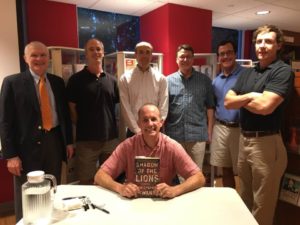
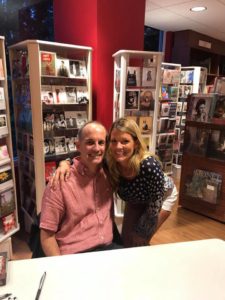
Afterward, I sat at a table by the cash register signing books. Some of my parents’ friends had dinner dates and dashed off, promising to get me to sign their copies later. One mom with her son who had just wandered into the store right before I read liked what she heard and so bought a copy. And then a woman stood before me, saying, “Well, hey, Swanny!” 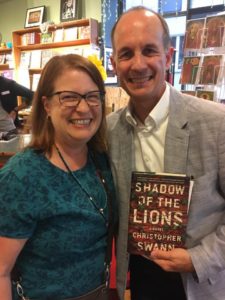 It was Martha, aka SmartyKate, an online friend I had never met before in person. Martha is one of the early members of the Fiction Files, a group launched on MySpace in the early 2000s by author Jonathan Evison. Johnny was just about to publish his first novel, All About Lulu, and the rest of the group consisted of avid readers and hopeful writers.* They had been my peer group, something I had missed after grad school. And now I was hugging Martha and signing a copy of my novel for her.
Then the line was gone and I stood up and stretched. Jacob came over, and I asked if the store had any copies they wanted me to sign. “We sold out,” he said.
My parents took our sons home with them so Kathy and I could go have a celebratory dinner. We found a local Italian place, Modesto. When we sat at our table, I put my copy of Shadow of the Lions face-down on the table. Kathy looked at me and then turned it face-up. A man and a woman dining next to us noticed. “My husband wrote a book,” Kathy told them, while I smiled and blushed and tried to look both proud and humble but probably just looked awkward. The woman took a picture of my book so she would remember it. The waitress was suitably impressed enough to offer us dessert on the house.
All in all, a great way to end the North Carolina leg of my tour.
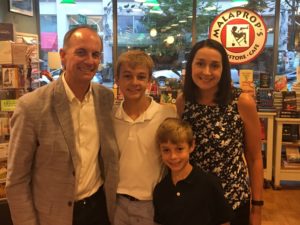
*Johnny Evison has gone on to publish four novels–All About Lulu, West of Here, The Revised Fundamentals of Caregiving, and This is Your Life, Harriet Chance!–with a fifth in the works. He has been a mentor and a friend to me, and now we are both Algonquin authors. Other Fiction Filers include Ben Loory, author of Stories for Nighttime and Some for the Day and the upcoming Tales of Falling and Flying; Hugh Schulze, writer and director of the film CASS; and James P. Othmer, author of The Futurist, Adland, and Holy Water.
 Park Road Books, located in a nice shopping center in Charlotte, looks relatively nondescript on the outside. Take a closer look through the large bay window–ignore the book on prominent display–and you’ll see something else. The front of the store has a small sitting area, almost like a casual living room with a fireplace. Behind that is the sales counter, and beyond that are the long, narrow alleys of bookshelves.
 I was sort of wandering around in the store half an hour before my event was supposed to start when a vaguely familiar man and his teenage son approached. “Chris Swann?” the man said. “I don’t know if you remember me. William Harris.” Mr. Harris was my ninth-grade Ancient History teacher at Woodberry. I had loved his class. He introduced me to his son, who had just graduated from Woodberry. They now lived in Charlotte, and had a prior dinner engagement, but he had wanted to stop by, get a copy of my book, and get my signature.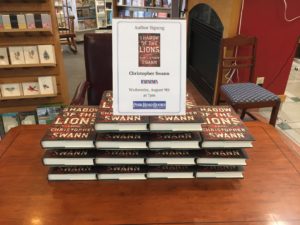
 I parked in the almost deserted parking lot just across the street and took a look. Like any place from childhood, Wiley seemed much smaller than I remembered it. I got out of my rental car and crossed the street, pulling out my phone to take a few pictures. The doors I had always gone in from the back were locked, so I walked around to the front to see if the school was opened. I recalled that my art teacher, an excitable man named Mr. Garibaldi or Mr. Grimaldi, had once thrown a chair out of a third-story window right above the spot where I was on the sidewalk, and I glanced up as if I would see a desk rotating through the sky on its way to the ground.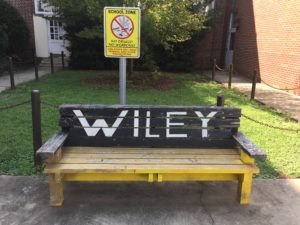
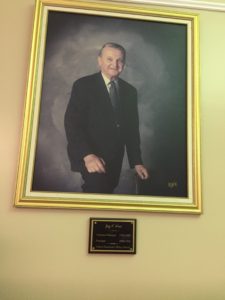

 The school’s name was Whitaker Elementary School. Almost twenty-five years after I left that school, my wife and I would name our firstborn son Whitaker. As the Police would sing in a popular album when I was a kid growing up in Winston-Salem: synchronicity.
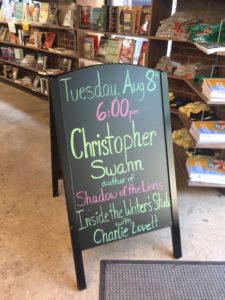 Bookmarks is another interesting independent bookstore. For several years, Bookmarks has been a literary arts organization that puts on a yearly books festival, but this summer they opened a new brick-and-mortar bookstore. It’s non-profit, and Bookmarks supports a variety of things, including an authors in schools program.
 Charlie, himself a Woodberry grad (class of ’80), brought his Woodberry letter jacket and draped it over the back of his chair for our interview. I enjoyed the conversation, although as usual, despite Charlie’s assurances to the contrary, I maybe went on a bit too long in my answers. What was just as enjoyable was talking with folks before and afterwards. Jule Banzet, another Woodberry grad, brought his two sons, one a current fourth or fifth former and the other a hopeful future Tiger. His youngest son approached me afterward as I was signing books and asked me very politely why I had called my book Shadow of the Lions. Not sure I would have been able to do that at his age.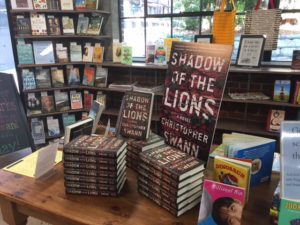

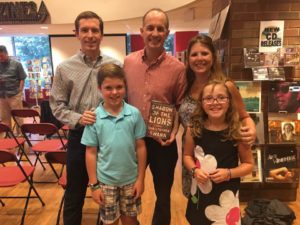 I arrived about fifteen minutes ahead of my event with my cousin Will and his family after we had all gone out for an early dinner. His son and daughter did their best to help sell their dad’s cousin’s book.
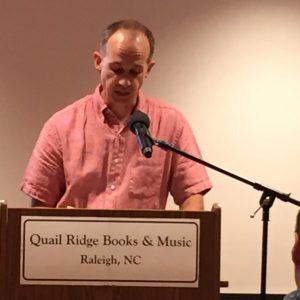 Then I was standing at a microphone in front of a crowd of twenty-five people, all of whom wanted to hear about my book. I read from the prologue, talked a bit about the origins of the story, and said of my protagonist Matthias, “I like characters who make mistakes.” (That last bit got tweeted out by Algonquin via my publicist.) I tried not to ramble, probably did a little bit anyway, but then got into a groove and spoke for maybe half an hour. The Q&A with the audience was interesting. A gentleman asked how I saw the difference between redemption–which I had said my protagonist Matthias was searching for–and salvation. Lynette raised her hand and asked if I had any advice for aspiring authors, which caused her teenage daughter to nearly die from mortification. A lovely young woman who I realized was a former student of mine, Meredith, asked if I had ever, in the middle of teaching class, been struck with an idea to put in my novel.