The story of Parnassus Books and its origins is already legendary. (Read it here if you haven’t already.) Yes, I hoped to walk into the store and meet Ann Patchett, who would then happily sign my worn copy of Bel Canto. I had also hoped to meet Mary Laura Philpott, editor of Parnassus’ online magazine, and see if she is as funny and delightful in person as she is online. (I had previously learned that she would be out of town.) But more than that, I simply wanted to walk into the store and find that special something that bookstores–real bookstores–have.
Parnassus has that. In spades. And no, it’s not because they had a big old display of my novel right at the front.
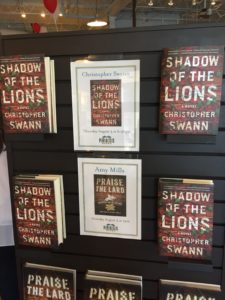
I have long lamented to anyone who wants to listen — and probably to several who did not — the loss of Oxford Books in Atlanta, the last unique independent bookstore in Buckhead. Oxford Books has been gone for several years now. Walking into Parnassus was like walking into Oxford Books 2.0. The floor plan is open and brightly lit without being drenched in harsh fluorescents. The shelves are packed with books and dotted with handwritten notes from the staff highlighting certain texts. Books cover a series of tables without being messy and are organized without seeming arranged by a fascist.
A young woman behind the cash register saw me wandering around the shelves. “You’re tonight’s author!” she said brightly. She took me to the back office to introduce me to Niki Coffman, who was in charge of the evening’s event. Niki wore a lovely sweater with some sort of shawl or scarf. It wasn’t until about fifteen minutes later that I realized the shawl was actually a sling holding a very mature long-haired dachshund. “This is Mary Todd Lincoln,” Niki told me. Mary Todd Lincoln glanced at me and snuggled closer to Niki.
I’m not sure if there is some sort of magical hiring process at Parnassus, or if the store just draws the right people in. Regardless, Niki was everything you would want in a bookseller: warm, friendly, passionate about books, a good asker of questions and a good listener, and wearing a dachshund in a sling. She asked about my tour and whether or not I was driving a lot, which led to a conversation about audiobooks. When I confessed that I had not yet read Ann Patchett’s novel Commonwealth, Niki dug around on a shelf and found a CD audiobook version of Commonwealth narrated by Hope Davis. She handed it to me. A gift, she said, “for all the driving you’ll be doing on your book tour.” Feeling like a stalker, I asked if Ann Patchett were around, and held up my worn copy of Bel Canto which I had brought from Atlanta for the sole purpose of looking like a fanboy desperately hoping to get his favorite band to sign his album cover. Nope, Niki said, she’s heading to the beach tomorrow morning. “But just leave it with me and I’ll get her to sign it at some point,” she said. “Oh, and if you want to buy anything in the store, you get the author discount.”
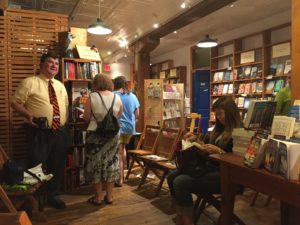
There was still time before the event, so I went back out into the store, determined to make good on the author discount. Staffers were setting up folding chairs; it looked like they were setting up a lot of them. I picked up a copy of Colson Whitehead’s The Underground Railroad and Kate Quinn’s The Alice Network, then saw another Algonquin debut novel, When the English Fall by David Williams, and put The Underground Railroad back on the shelf for another day in favor of David Williams’ book. At the sales desk, I bumped into HI alum Avery Robinson, who had come straight from work for my event. As always when I see a former student after a few years, I was stunned by how grown up Avery seemed. I don’t mean she had been immature and could now be trusted to use the right dinner fork; I mean she had transformed from a teenage girl into a young, confident woman. She had the same bright smile and engaging air she had always had, and we chatted for a minute before I went to get a drink of water. Fifteen minutes until show time.
Ed Tarkington appeared, along with his wife Elizabeth-Lee and their two young daughters. Ed and I shared an editor, Andra Miller, before Ballantine hired Andra away from Algonquin. Ed is also a high school English teacher and had his first novel published by Algonquin last year, and since then we had become friends. Tonight we would be having a conversation about my book in front of however many people would come. We sat down in the back to talk about what Ed would ask me and if I should read a short passage aloud or not. Niki came back and said we had about five minutes until go time. She paused and looked at me. “I think you are going to like the crowd size,” she said.
We then stepped out of the back office and through the kids’ books section to the center of the store, where there was a small stage with two leather club chairs in front of a signing table. There were easily twenty people in the seats, with more straggling in. I keep reading stories about debut authors going to bookstores and speaking to groups of five, or three, or sometimes two, counting the salesclerk. Ed had clearly spread the word for me, and I had also had some good press. Then I saw Maryanne Stumb McWhirter, another HI alum, with a group of friends. Go Bears!
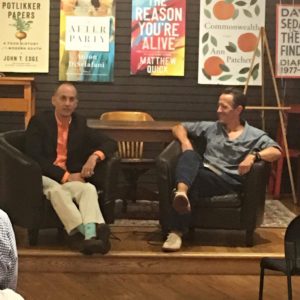
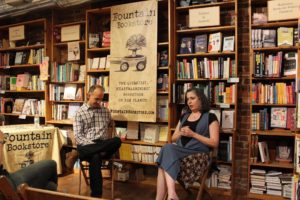
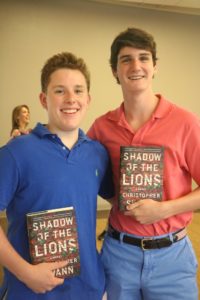
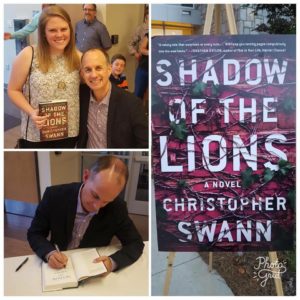
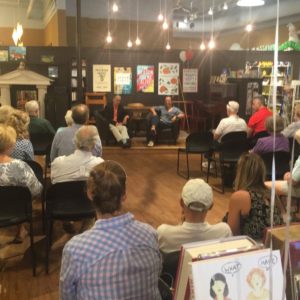 Niki introduced Ed, who introduced me, all to a nice round of applause. We had microphones but elected to ditch them, using our teacher voices to project to the back of the audience. Ed was the quintessential interviewer, displaying his knowledge and understanding of my book but leaving me plenty of room to answer his questions and to elaborate. People laughed politely but sincerely at my jokes. I read the opening two-and-a-half pages of my novel and Ed led the audience in another round of applause. I’ve grown more comfortable talking about my book in the past few days, so it was more than okay. It was fun. The audience asked lots of questions: did I plot out the mystery of Fritz’s disappearance beforehand or let it develop organically as I wrote; do I write for a particular reader or kind of reader in mind; how did I find time to write (short answer: my butt goes in the writing chair for an hour or so after the boys go to bed). Afterwards people bought copies of my book and I signed them, an activity that I still find delightful. Maryanne bought four copies. A third HI alum, Ashley Bahl-Binder, appeared with a hug and a book for me to sign. Never in my life had I thought about how deep and wide the social net of HI alums would be, nor how beneficial it would be for a book-touring English teacher.
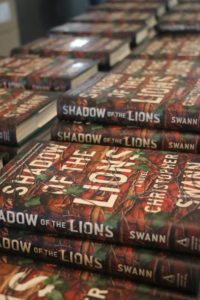
 Finally, the customers were all gone, and the Parnassus staff told me it had been a fabulous turnout. Then they asked me almost hesitantly if I would mind signing the rest of their copies. “Gladly,” I said. Ed and Elizabeth-Lee left with their daughters amid promises for Ed and I to get together tomorrow morning for coffee. I really didn’t want to leave, but I knew the staff needed to get home, so I finished signing the books. They also brought me a Moleskine notebook the size of a flatscreen TV as a sort of guest book that visiting authors sign. Their most recent book was full, so I got to be the first to sign in a brand-new one.
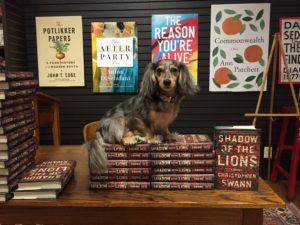
That’s when Niki approached with Mary Todd Lincoln. “Okay, I have a strange request,” she said, “and feel free to say no. Would you like to have a picture of your signed books with Mary Todd Lincoln?” She smiled. “She’s famous on social media.”
“You want to put a cute dachshund on top of a stack of my books?” I said. “Wait until I get my phone.” And so I present you with this picture.
I went back to the office to collect the two books I had bought, along with the audiobook of Commonwealth and my old copy of Bel Canto. Niki held her hand out. “You can leave that here,” she said, meaning Bel Canto. “I’ll get Ann to sign it. You can come pick it up tomorrow morning. We open at ten.”
“Tomorrow?” I said. “But you said Ann is going to the beach tomorrow.”
“Yeah,” she said. She picked up her phone. “I’ll call her and see if she can sign it tonight.”
“Seriously?”
Niki shrugged and smiled, as if to say This is what we do.
[Update: Ann Patchett did sign my copy of Bel Canto. Wrote a really nice note, too. Achievement unlocked.]
Next stop – Alabama Booksmith in Homewood, AL!
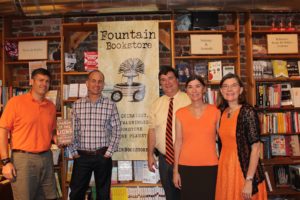
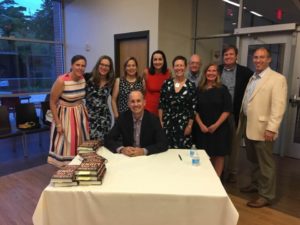
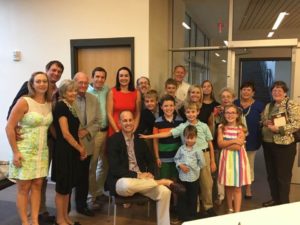
 night before, and yet this feels right, more intimate. The customers are attentive and listen as Kelly asks me questions and I try to respond without babbling or wandering off-track. Another former Woodberry classmate, Mike, arrives and waves from the back row. I’m asked about the title, about working under an honor code, how long it took to write the book, did I always assume I was writing a “literary thriller” and what does that mean, which authors inspire me. My former student Katie asks me if being an English teacher helped me in the writing of my own book or if it got in the way. (Yeah, she’s smart.) I answer everyone’s questions and then sign books. My friend Beverly arrives near the end and waits until the store empties. Before everyone leaves I get a picture with the Woodberry folks, and then Kelly has me sign all her remaining copies of my book. Seeing them stacked afterwards with “Autographed Copy” labels on them is yet another realization that this book thing is really happening.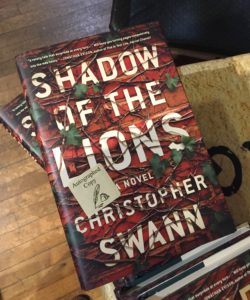
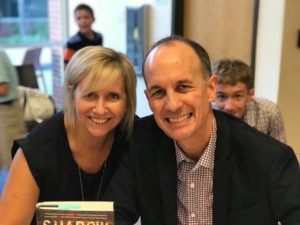
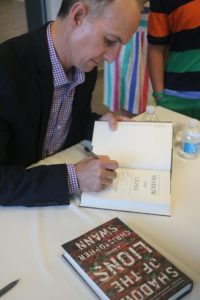 It was like being at my wedding, where I spoke with every single person there, but only for about 2 minutes each. My friend Emily Giffin, a bestselling author and book party pro, came up and told me to move my table — there was a large fire alarm box on the wall behind me, which was right in the sight line of every picture being taken of me. We moved the table and I kept on signing. At one point I started asking everyone how to spell their name because I was afraid I’d misspell them and ruin their books. Carla, a former colleague, came up to hug me, then started brushing my jacket. “You’ve got makeup all over your jacket, Dr. Swann,” she said. “You’ve been hugging women.” Guilty.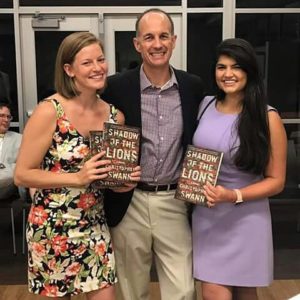
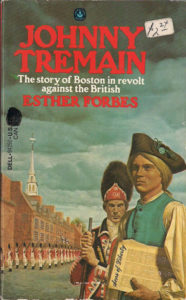 As Mrs. Corpening marched our eighth-grade class into the Revolutionary War, she announced that the unit would culminate in a Project. Everyone at Wiley Junior High knew about the Project. The girls would make patchwork quilts and dolls out of calico and stuffing, and the boys would write a book report on Johnny Tremain. This year, however, Mrs. Corpening presented us with another option that grabbed hold of me by the front of my shirt: we could write a diary—or, for the boys, a journal—from the point of view of a fictitious character living during the Revolutionary War.


