
Second novel syndrome. The sophomore novel. The curse of the second novel.
Google “the second novel” and these are the titles of the first three search results.
I’m now an officially published author. I have an agent, that magical unicorn hopeful writers search for, sometimes for years. I have a first novel that sold well enough to earn back its advance and then some. It–and I–got nominated for awards and even reviewed in The New York Times Book Review. I’ve met lots of other writers, some of them famous, and made a lot of new friends in the publishing world.
I got to go to the private writers-only party at the Decatur Book Festival, y’all. I have arrived.
All of which means exactly nothing when you sit down to write book number two.
That’s not entirely true. Having published a book is a glorious thing, and one should be proud of that accomplishment. Having a literary agent means someone else can do the heavy lifting of selling your first book while you focus on writing the next one.
But when you are sitting in front of your blank laptop screen, it sure feels like it means nothing.
Because now you are an Author. And as an Author you have a Reputation, which is based on Book Number One. So Book Number Two better be as good. Scratch that–it has to be better. Because if not, you’ll be a One-Hit Wonder. Maybe it was luck that everything broke your way for the first book. You can write a sentence, sure, even a respectable scene. But a book? Don’t you know how hard it is to write a whole book?
But you were able to write a book already, says a small but determined voice in your head. And people said it was good.
That’s sweet, kid. Congrats. Here’s a balloon. Now listen carefully: that was that book. Not this book. This book, the new one? It’s an entirely different thing. It’s like having kids–you have one, you think you’re an expert, so you have another and then wonder how the hell the first one is still alive, and you don’t remember diapers being this difficult to put on your first kid, who was sleeping through the night at six weeks, by the way, so how come baby #2 didn’t get the memo?
Writing a second book is like that.
Years ago, I coached varsity girls soccer. One practice, one of my players, Beth, was struggling with penalty kicks–she kept overpowering it and kicking the ball over the goal. When she tried to correct it, she overcorrected and either kicked the ball straight to the keeper or shanked it far to one side or the other. She was furiously cursing under her breath and getting more wound up with each failed attempt. I calmly tried to explain to her how not to overshoot the goal, and, frustrated, Beth said, “Okay, Coach, why don’t you do it?”
Everyone around us froze. Even the grass stopped growing for a minute. I was young, maybe 24 years old, and a new coach, and this 17- or 18-year-old student had just thrown down a gauntlet at my feet. What would Coach do?
I shrugged. “Okay,” I said, and I lined up three balls for penalty kicks. “So,” I said, “you can aim for one of three places. You can aim high–” and I kicked the ball hard at the top-left-hand corner of the goal. The ball sailed past the keeper’s outstretched fingers and into the net. “Or you can aim in the middle,” I said, and I drilled the second ball waist-high past the keeper–goal. “Or low,” I said, and I ran forward and kicked the third ball hard enough that it didn’t even spin, just shot about ankle height past the hapless keeper’s legs. Goal. This all happened in less than ten seconds. The keeper gaped at me. Everyone did. I glanced at Beth, who was staring at me. “Like that,” I said, as if I’d just showed her how to close a book, and then I walked over to the bench to get my water bottle.
Here’s the thing: I had never shot on goal like that in my life. It was a one-in-a-million event, a perfect aligning of the planets, a miracle. I knew I would never, ever be able to pull that off again. But I also knew that I would probably never have to even try.
Sitting in front of my laptop at the start of book number two, I felt as if I now had to attempt all three PKs again, except this time against Hope Solo.
It’s a crazy kind of pressure, writing the sophomore novel. And most of that pressure is self-inflicted. No one wants you to fail. Everyone is rooting for you. Sure, it’s hard starting a second book while you’re still either editing the first book or out there talking about it. You have to get creative and disciplined with your time. You have to learn to write book number two as its own thing, with its own demands and challenges that are different from the ones your first book had. You have to try and be willing to fail, because you will fail. Something won’t work–a character, an exchange of dialogue, a whole scene, maybe an entire chapter, maybe even the entire first draft.
You have to be prepared to live with that, and muster up the strength to keep going.
Because you’ve gotten this far. You’ve got an agent. And an editor. You’ve even got a publicist. They’re your team.
But most of all? You have yourself and all the talent and hard work and imagination and luck that you drew from to write your first book. You did it.
And now you’ll have to do it again. One page, one sentence at a time.
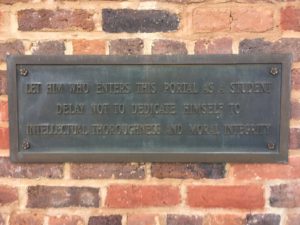

 But my favorite question of the afternoon was from a classmate I hadn’t seen for thirty years.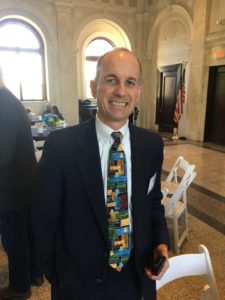
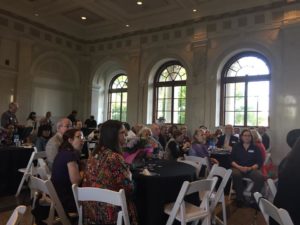 Authors, I’ve found, are typically generous and encouraging souls. I wasn’t disappointed when we finally returned to our table and met some of the other finalists, including Stacia Pelletier, Man Martin, and Jonathan Rabb. All of them were very pleasant and chatty. If they were nervous about the award, they fooled me. Of course we all wanted to win, but I knew I was lucky just to be nominated, and besides, direct competitions between authors feel awkward. Jonathan Rabb and I talked about that, agreeing that it was a bit embarrassing. A young man with neatly slicked-back hair came over from the next table and stuck out his hand and introduced himself as Tom Mullen. He was a Townsend finalist for Lightning Men, the second in his series about the first black police officers in Atlanta in the 1940s and ’50s. He asked if I was local, and after chatting for a few minutes he went to go meet some of the other authors, but not before saying we should get together sometime over coffee.
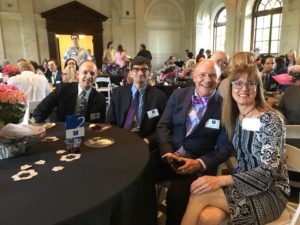 I sat down and finished eating my dinner when my phone dinged–a good luck text from my friend Clarissa, who had given me a Blackburne t-shirt at my launch party. This was followed by another text, this one from Brian Panowich, the author of Bull Mountain, who I had also met in Augusta and who had told me he loved Shadow of the Lions. He wished me luck and added, “Have fun–enjoy the moment.” I showed both texts to Kathy, and suddenly my eyes stung and I had to blink back tears. I’m a high school English teacher who cries at sunsets and supermarket openings, but at this moment I realized that I was now a legitimate author, an honest-to-God novelist, who was drinking wine and rubbing elbows with Georgia literary royalty, as Anna Schachner would later pronounce from the podium.
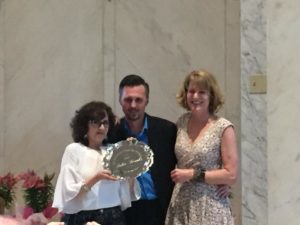 In the end, the lovely Julia Franks won the Townsend Prize for Over the Plain Houses, and everyone cheered. Julia could not find a major publisher to buy her book, and so she went with the smaller Hub City Press in Spartanburg, S.C. We were all thrilled for her. She was perhaps the only one who was astonished that she had managed to win.
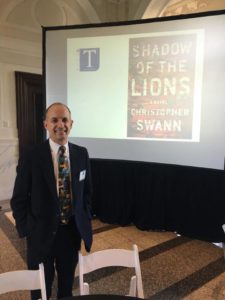 The writers I have met are some of the most generous and supportive people I know. Anna said that all the finalists were winners, and she was right. Julia had not beaten the rest of us; she had rightfully won a prize that celebrates her but also reflects well on all of us. I’m sure there are selfish and catty writers out there, but I want to remain ignorant of them for as long as I can. I’m proud to know these folks, and to be known by them and accepted into their circle. I’ll make sure that if I continue to have success with this writing gig and am ever in a position to welcome and encourage another author, I’ll do it without hesitation. These other authors have done the same for me, and that’s one of the best prizes I could hope to get.


