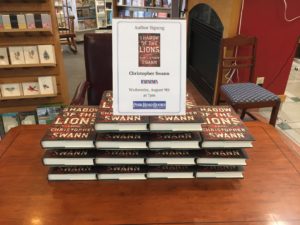
(Thanks to friend and fellow author David Abrams (go read his book BRAVE DEEDS) for posting this piece I wrote on his blog The Quivering Pen.)
When I was an undergraduate student at Washington and Lee, the author Richard Ford visited campus. I had read his short story “Rock Springs” and his most recent novel at the time, The Sportswriter, and I vaguely understood that he was a Serious American Author, an up-and-coming big deal in the world of American literary fiction. One of my professors, Jim Warren, invited me and another creative writing student, Traci Lazenby, to dinner with Richard Ford. Moreover, we would each submit a piece of writing for Ford to read, and he would give us feedback in a subsequent one-on-one workshop with him the next day.
We had dinner at one of the fancier restaurants in Lexington, Virginia, the kind of place you only went to when your parents were in town and could take you out to dinner. Richard Ford was wearing khakis and a white shirt and a dark tie and a lived-in blazer, the kind he probably wore when he sat down at his typewriter and pushed his sleeves back to the elbows before writing. I immediately regretted my own blazer, which had brass buttons and made me look, I was certain, like a little boy going to church for the first time. I remember Ford asked the waitress for a Bombay and tonic. This made an impression on me because my dad drank gin and tonics, and Bombay was his preferred gin. However, the waitress didn’t know what Bombay was, and Ford had to explain it to her. The waitress went to the bar but returned and said she was sorry, they didn’t have Bombay, but they had Tanqueray. Ford politely said that would be fine. I don’t remember much else about the dinner, except that Richard Ford epitomized East Coast cool while I mostly remained mute because I was afraid I’d make a fool of myself.
The next day I met Richard Ford in an empty classroom in Payne Hall—the House of Payne, we called it. I was nervous because this was the first time an actual, serious author who was not my instructor was going to read and evaluate my writing.
I was also nervous because no one else had read what I had sent to the celebrated author for his feedback. It was the opening chapter to a novel I’d begun about a college student, a frat guy, who likes to party and cruises on his smarts but secretly wants to be a writer, except he’s afraid to admit it. There was a James Earl Jones-like instructor, Professor Worthington, and a beautiful girl, a poet in the same creative writing class as the protagonist. The title of this tour de force was Wasted Time. (No one is more certain of his own cleverness than a college undergraduate.)
Richard Ford wore the same blazer he’d worn the night before, although he had shed the tie and, I assumed, was wearing a different shirt and khakis. He greeted me and shook my hand, but he seemed a little out of sorts as he sat there looking at me. He asked me which contemporary authors I liked to read. I froze. I was into Shakespeare and Chaucer and medieval literature. Contemporary? Every title of every contemporary novel I’d ever read vanished from my mind. Ford sat there patiently. If I said “Richard Ford,” I’d look like the worst kind of sycophant. Then a memory dropped like a bright penny: my high school English teacher had assigned Jay McInerney’s Bright Lights, Big City, which I had liked, so I said that. Richard Ford raised his eyebrows in surprise, and we chatted about Bright Lights, Big City for a minute. “I can’t believe we’re talking about Jay’s book,” Richard Ford said.
Jay’s book, I thought. He was on a first-name basis with Jay McInerney. It was like a hidden door to the world of authors had been opened. This was the real deal. And I wanted in. I wanted to write novels and to wear a lived-in blazer and to be able to say casually, some day, to a would-be writer, “Oh, you read Richard Ford’s book? Yeah, Rick and I were tossing back Bombay and tonics just last weekend. I can’t believe we’re talking about old Rick’s book.”
Then Richard Ford picked up the pages I had sent him to read and sort of looked at them, like there was something he wanted to say but he’d lost it in those pages. He leafed through them, then put the pages down and started talking. I don’t know what he said, because when he’d put the pages down, the last page was on top, and so I could read Richard Ford’s handwritten note on that last page. What he had written was, A really bad story.
Ford continued to talk, and somehow, through my embarrassment and basement-level self-esteem, I understood that he was talking about why my short story wasn’t working. When he paused to take a breath, I rushed into the opening. “This isn’t a short story,” I said.
“It’s not?” he said.
“No, sir,” I said. “It’s meant to be the opening chapter of a novel.”
“Oh,” he said, then looked down at the comment he’d written on the back page, A really bad story. He picked up a pen and reached over and crossed out the word really.
In the past, when I’ve shared this story, I’ve usually stopped there. I get to shrug and smile ruefully while my listeners laugh, and unlike real life that anecdote has a definitive zinger of an ending.
What actually happened was that, after a moment or two of looking down at my pages while I tried not to die of mortification, Richard Ford reached over again with his pen and crossed out the entire comment. He looked relieved, although nowhere near as relieved as I felt. And then he talked with me about the difference between short stories and novels, how to lay out a long narrative and use the opening to set up characters and conflicts.
I walked away from that meeting with a profound sense of relief that I had escaped unscathed. It was only much later that I came to appreciate what Richard Ford had done. He had shared his honest opinion of my writing, something all writers need to hear. When he learned that what I had written wasn’t a short story but the opening of a novel, he re-evaluated his opinion on the fly and offered his thoughts on how to approach writing novels. More than anything else, Richard Ford treated me seriously, as someone who wanted to write well and needed guidance on how to do so. He initiated me into the fellowship of writers.
In my long career as a high school teacher, I have met several students who want to write, all of them eager and anxious, all of them wanting to know if they are any good. An unthoughtful critique or a dismissive word from a teacher could be devastating. Richard Ford was kind enough to be both honest and encouraging, and so I hope to be able to pay that forward, to offer candid and supportive feedback, to help a young would-be writer think that he or she just might be able to do this after all.
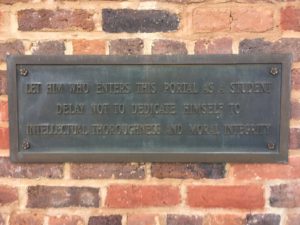

 But my favorite question of the afternoon was from a classmate I hadn’t seen for thirty years.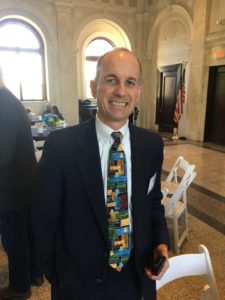
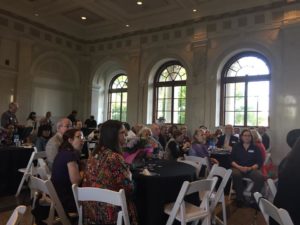 Authors, I’ve found, are typically generous and encouraging souls. I wasn’t disappointed when we finally returned to our table and met some of the other finalists, including Stacia Pelletier, Man Martin, and Jonathan Rabb. All of them were very pleasant and chatty. If they were nervous about the award, they fooled me. Of course we all wanted to win, but I knew I was lucky just to be nominated, and besides, direct competitions between authors feel awkward. Jonathan Rabb and I talked about that, agreeing that it was a bit embarrassing. A young man with neatly slicked-back hair came over from the next table and stuck out his hand and introduced himself as Tom Mullen. He was a Townsend finalist for Lightning Men, the second in his series about the first black police officers in Atlanta in the 1940s and ’50s. He asked if I was local, and after chatting for a few minutes he went to go meet some of the other authors, but not before saying we should get together sometime over coffee.
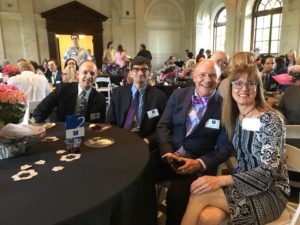 I sat down and finished eating my dinner when my phone dinged–a good luck text from my friend Clarissa, who had given me a Blackburne t-shirt at my launch party. This was followed by another text, this one from Brian Panowich, the author of Bull Mountain, who I had also met in Augusta and who had told me he loved Shadow of the Lions. He wished me luck and added, “Have fun–enjoy the moment.” I showed both texts to Kathy, and suddenly my eyes stung and I had to blink back tears. I’m a high school English teacher who cries at sunsets and supermarket openings, but at this moment I realized that I was now a legitimate author, an honest-to-God novelist, who was drinking wine and rubbing elbows with Georgia literary royalty, as Anna Schachner would later pronounce from the podium.
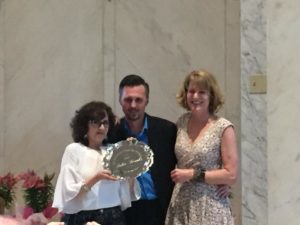 In the end, the lovely Julia Franks won the Townsend Prize for Over the Plain Houses, and everyone cheered. Julia could not find a major publisher to buy her book, and so she went with the smaller Hub City Press in Spartanburg, S.C. We were all thrilled for her. She was perhaps the only one who was astonished that she had managed to win.
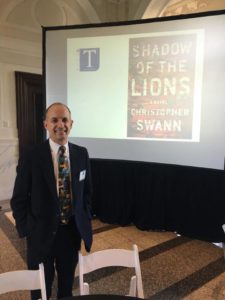 The writers I have met are some of the most generous and supportive people I know. Anna said that all the finalists were winners, and she was right. Julia had not beaten the rest of us; she had rightfully won a prize that celebrates her but also reflects well on all of us. I’m sure there are selfish and catty writers out there, but I want to remain ignorant of them for as long as I can. I’m proud to know these folks, and to be known by them and accepted into their circle. I’ll make sure that if I continue to have success with this writing gig and am ever in a position to welcome and encourage another author, I’ll do it without hesitation. These other authors have done the same for me, and that’s one of the best prizes I could hope to get.
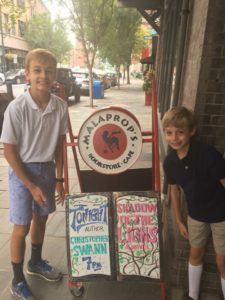 On setting foot inside the store, both boys began roaming the store, peering at shelves. Sullivan wanted the next book in Alan Gratz’s The League of Seven series. Whitaker was drawn to Malaprop’s “blind date” shelf of books wrapped in brown butcher paper. The staff writes a few choice adjectives for the wrapped book on the outside of the paper, and those are the only clues as to what kind of story is hidden beneath the paper. Whitaker carefully chose one, which turned out to be The Madman’s Daughter, a revisioning of H.G. Wells’ The Island of Doctor Moreau.
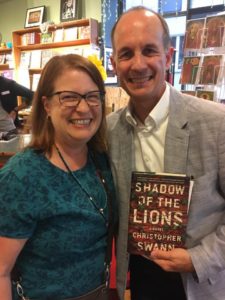 It was Martha, aka SmartyKate, an online friend I had never met before in person. Martha is one of the early members of the Fiction Files, a group launched on MySpace in the early 2000s by author Jonathan Evison. Johnny was just about to publish his first novel, All About Lulu, and the rest of the group consisted of avid readers and hopeful writers.
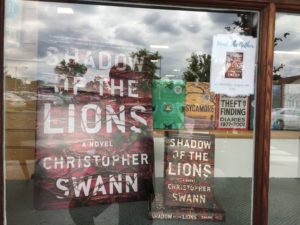
 Park Road Books, located in a nice shopping center in Charlotte, looks relatively nondescript on the outside. Take a closer look through the large bay window–ignore the book on prominent display–and you’ll see something else. The front of the store has a small sitting area, almost like a casual living room with a fireplace. Behind that is the sales counter, and beyond that are the long, narrow alleys of bookshelves.
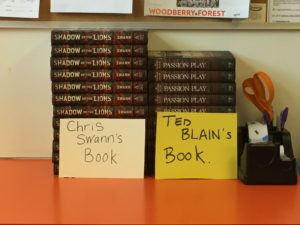
 I was sort of wandering around in the store half an hour before my event was supposed to start when a vaguely familiar man and his teenage son approached. “Chris Swann?” the man said. “I don’t know if you remember me. William Harris.” Mr. Harris was my ninth-grade Ancient History teacher at Woodberry. I had loved his class. He introduced me to his son, who had just graduated from Woodberry. They now lived in Charlotte, and had a prior dinner engagement, but he had wanted to stop by, get a copy of my book, and get my signature.