• Skip to main content
  • Skip to footer

CHRISTOPHER SWANN

Author of NEVER BACK DOWN

  • About
  • Books
    • Myopic Duplicity: A Crime Thriller Anthology
    • Never Back Down
    • Never Go Home
    • Trouble No More: Crime Fiction
    • A Fire in the Night
    • Never Turn Back
    • Shadow of the Lions
  • Blog
    • Why Do We Write? (9/20/25)
    • Every Word Is a Win (6/23/25)
    • The Write Now Podcast (3/19/2024)
    • The best crime fiction that features powerful female characters (7/17/23)
    • Interview with author T. M. Dunn (6/28/2023)
    • Sometimes, We Want Complicated (9/6/2022)
    • Friends & Fiction Fall Season Kickoff (8/17/2022)
    • Friends & Fiction Interview (12/1/2021)
    • Six Great Novels with Mysterious Protagonists (9/10/21)
    • Why I Write About Crime (11/22/20)
    • Novel Number Two (10/5/20)
    • Writing #coronaverse (5/21/20)
    • My First Time Meeting an Author (8/26/19)
    • This is not the America in which I want to live (8/13/2019)
    • WFS 30th Reunion: “Where are the lions?” (7/24/2019)
    • Townsend Prize for Fiction Ceremony (4/19/18)
    • Malaprop’s in Asheville, N.C. (8/10/17)
    • Park Road Books in Charlotte, N.C. (8/9/17)
    • You Can’t Go Home Again? (8/9/17)
    • Bookmarks in Winston-Salem, N.C. (8/8/17)
    • Quail Ridge Books in Raleigh, N.C. (8/7/17)
    • Alabama Booksmith in Homewood, AL (8/4/17)
    • Parnassus Books in Nashville, TN (8/3/17)
    • Fountain Bookstore in Richmond, VA (8/2/17)
    • Book Launch for SHADOW OF THE LIONS (8/1/17)
    • Write What You Know, With a Vengeance (5/14/17)
  • Events
  • Editorial Services
  • Contact

POSTS

Book Launch for SHADOW OF THE LIONS

August 2, 2017 by Christopher Swann

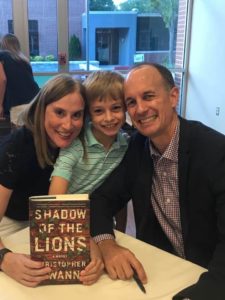
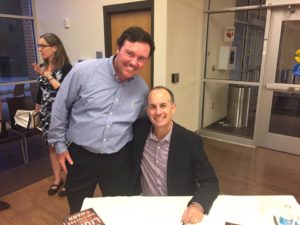
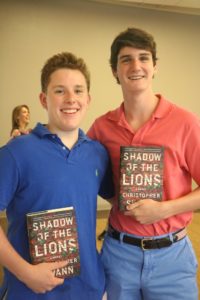
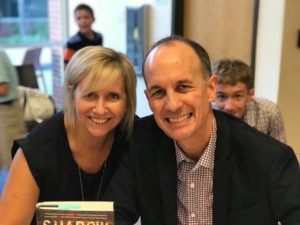
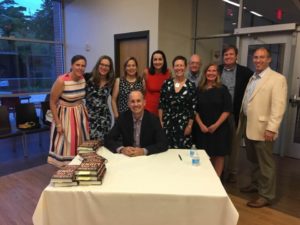
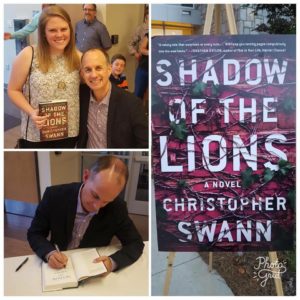
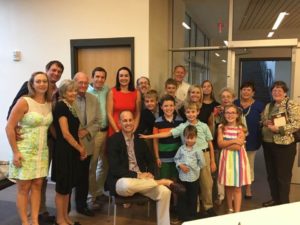
Last night was the book launch party for Shadow of the Lions, and I’m still stunned by the whole event. It was the most pleasantly surreal experience of my life. College friends, work colleagues, family members, former students, current students, parents of former and current students, Atlanta friends, friends from out of state . . . I’m still reeling from it all.

You only get to launch your debut novel once, and this was memorable. Holy Innocents’ Episcopal School, where I have taught for over twenty years, hosted the shindig. Gary Parkes, of FoxTale Book Shoppe, was the onsite seller. The first thing I saw when I walked into the STEM building was a long table covered with my books. He had brought 300 of them.
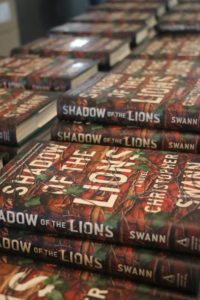
Julie, our school photographer, asked me to come with her to do some test shots with her camera. She sat me down and interviewed me, videotaping my responses, and I tried to look both comfortable and wise. Afterward she asked if I would sign her book for her. Julie was the very first person outside of my family whose book I signed.

Gary asked me to come sign a couple dozen copies of the book. Suddenly guests started arriving. I spoke with a small group of four or five people, and when I next looked up the room was packed. Where had they all come from? People were congratulating me, asking me if I could sign their books, asking how I felt, would I write a sequel, did I want a drink. Kathy caught my eye — it was time for me to give my little speech. But where was Paul Barton, our head of school? He was supposed to introduce me. While I was looking for him, my friend Clarissa brought me a gift bag. “You have to open it,” she insisted. In the bag was a custom-made T-shirt with BLACKBURNE, the name of the fictional school in my novel, across the front, all in Blackburne’s red-and-gold colors. Best present ever.

Finally I found Paul and extricated him from a conversation with a parent. “Ready to do this?” he asked me, then walked up to the front of the room. He gave me a very kind introduction, then handed me the microphone. I looked out at something like three hundred people and had a moment of stage fright, and then I took a breath and was fine. I spoke briefly about my career as a teacher, my book, how long I’ve wanted to write, and how thankful I am for Holy Innocents’, my publisher Algonquin Books, my agency Foundry Lit + Media, my family, and my wife. I only had to pause three times from almost weeping with gratitude.

Update: the school videotaped the whole thing.


Then I sat down at a table and signed books for an hour and a half.
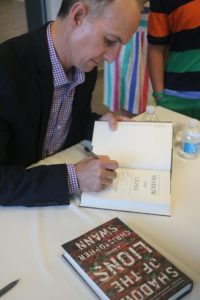
It was like being at my wedding, where I spoke with every single person there, but only for about 2 minutes each.  My friend Emily Giffin, a bestselling author and book party pro, came up and told me to move my table — there was a large fire alarm box on the wall behind me, which was right in the sight line of every picture being taken of me. We moved the table and I kept on signing. At one point I started asking everyone how to spell their name because I was afraid I’d misspell them and ruin their books. Carla, a former colleague, came up to hug me, then started brushing my jacket. “You’ve got makeup all over your jacket, Dr. Swann,” she said. “You’ve been hugging women.” Guilty. 
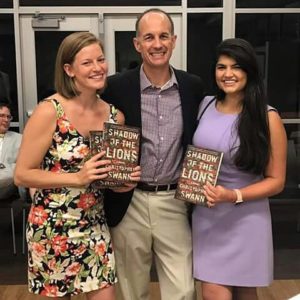
 

The bartender kept circling by to see if I wanted a drink. I did, but it was the last thing I needed. I kept signing and smiling and laughing. A few friends had to duck out early and waved from the door. My older son Whitaker told me the bookseller had sold every copy of my novel. Some of my neighbors gave up on waiting in line and promised to hold a neighborhood book signing party soon. A former student, smelling of hops, declared how happy he was for me. And then suddenly I signed the last book of the night and everyone was gone, except for my wife, my sons, and my college friends, who all cheered when I finally held up a glass of wine and took a sip.  Kathy took the boys home and I ended the night going out for a much-desired and perhaps well-deserved drink with my friends, some of whom I hadn’t seen in years.

My only regret is that I can’t do that again. But, man, did that feel good. Thanks to everyone involved in making this happen. This newly-minted author feels proud and grateful.

On to the book tour! Next stop – Fountain Bookstore in Richmond, VA.
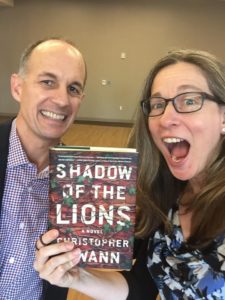
   

Filed Under: POSTS Tagged With: book launch, book tour

Write What You Know, With a Vengeance

May 14, 2017 by Christopher Swann

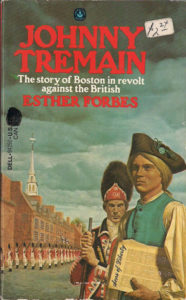
As Mrs. Corpening marched our eighth-grade class into the Revolutionary War, she announced that the unit would culminate in a Project. Everyone at Wiley Junior High knew about the Project. The girls would make patchwork quilts and dolls out of calico and stuffing, and the boys would write a book report on Johnny Tremain. This year, however, Mrs. Corpening presented us with another option that grabbed hold of me by the front of my shirt: we could write a diary—or, for the boys, a journal—from the point of view of a fictitious character living during the Revolutionary War.

Most of my classmates were puzzled or annoyed by this choice. I was thrilled. This was the first time at school that someone had asked me to write creatively. As a child, I read books everywhere—including the dinner table, to my father’s bemusement—and I had a vivid imagination that allowed me to transform my backyard into an Army base, an undersea laboratory, or a space station. I also played Dungeons and Dragons and other RPGs, which were all about inventing stories and characters and entire worlds in your head. Who wanted to write a stupid book report on Johnny Tremain? Instead, I invented a frontier woodsman who was swept up by the Revolution and fought in the Battle of Kings Mountain in South Carolina. In that battle, the death of the British commander sealed the Patriot victory. Of course, my character was the hero who shot the British commander.

What I loved about that assignment was the sheer audacity of the idea that I could make up whatever I wanted. I scanned the encyclopedia and my social studies textbook for background info, but otherwise, the story was all mine. It was like the best kind of daydreaming, except with the permanence of ink on a page.

*   *   *

After eighth grade, I left the Winston-Salem public school system for boarding school in Virginia. There my classmates and I felt that a lot was expected of us, that the stakes had been raised. I dutifully buckled down and learned how to write a persuasive five-paragraph essay, my eighth-grade creative journal consigned to a drawer and forgotten.

In my fifth form or junior year, however, Mr. Blain, who taught the novel genre, created an unusual assignment for us. Mr. Blain was tall and slim and wry, and he would often stand at the front of the room and lean back against his desk, arms folded comfortably across his stomach. He did this as he told us about our assignment. “We’re going to study the novel,” he said. “And we shall read a lot.” He paused and smiled. “But this trimester, you are also going to write a novel.”

We weren’t sure we had heard correctly. Write a novel? We were going to write a novel? Ourselves?

That is exactly what we did. Fifteen students, fifteen chapters, one per student. Any topic, any plot, any writing style of our choosing. “Barring egregious and unnecessary profanity and pornography,” Mr. Blain added, which led to a few muffled groans. We made committees—Character, Plot, Setting. I was on the Plot committee, where I sensed the action was. And I wanted in. I wanted to help decide what would happen. And so I volunteered to write the opening chapter.

The novel, such as it was, told the story of Trip, a senior lacrosse player at an all-boys boarding school. “Write what you know” was advice we all took, although we took liberal creative license with this rule. Trip discovers there is a drug ring on campus run by—gasp!—the assistant headmaster and disciplinarian. The novel, entitled Class Ring, is choppy, self-contradictory, and highly unbelievable. But it was a watershed moment for me as a writer. I think it was an important moment for everyone in that class. We would talk about the possibilities for our novel in class, on the way to practice, walking back to the dorms from dinner. We argued about the fate of various minor characters. We gave Trip a sidekick and accomplice, Walter, an unpopular nerd who sorts tee shirts and socks in the school gym. Mr. Blain made comparisons to Don Quixote and Sancho Panza that flew right over our heads, but we beamed at his praise nonetheless. We were writing a Novel.

*   *   *

“Write what you know” is perhaps the best-known advice that is given to writers. It made sense to me when I first heard it. But then, at the impressionable age of an undergraduate discovering his lifelong passion, I read John Gardner’s The Art of Fiction. In it, Gardner cautions the writer about write-what-you-know: “Nothing can be more limiting to the imagination, nothing is quicker to turn on the psyche’s censoring devices and distortion systems, than trying to write truthfully and interestingly about one’s own home town, one’s Episcopalian mother, one’s crippled younger sister.”[1] This floored me. It also freed me, I thought. I could write whatever I wanted. It’s not that I felt ashamed or embarrassed about my own life. It’s that my life felt, well, boring. I wasn’t born on the lip of a volcano, or the child of secret agents, or haunted by some dark, secret tragedy. My father was a banker, my mother a homemaker. I had gone to boarding school and then to a small liberal arts college. What did I know from my own personal experience that I could possibly turn into fiction?

So I decided to write about things I didn’t know about.

*   *   *

Fast forward twenty years and I have a Ph.D. in creative writing, a teaching job at a private school in Atlanta, two young boys, and a fiercely intelligent wife. She is also patient, which helps when you are married to a would-be novelist.

I had spent more than a decade writing a novel set partially in Ireland and dealing with family drama, the IRA, and the sins of the past. It was my dissertation, and I learned how to write by constantly trying to hack my way to the story at the center of that thing, but the novel never quite came together. After reading yet another draft of it, my wife said, not unkindly, “Why don’t you write about something you know?”

“I’m a white Southern male who went to boarding school,” I said. “I teach high school English. Who wants to read that?”

“You don’t have to write about that,” my wife said, patiently. “But you could write a story that takes place at a boarding school.”

I resisted at first. I love Dead Poets Society and The Catcher in the Rye, but I didn’t want to copy those stories. I was also intimidated, truth be told. And John Gardner’s advice still lingered. But the Irish novel wasn’t responding to my latest attempts to flog it into shape. And I did have an idea about a young teacher plagued by an event from his own student days.

My wife encouraged me to explore this new story. “Give it a prologue where something shocking happens,” she said. “Like somebody dies.”

I considered this. “No, he doesn’t die,” I said. “He vanishes.” And I went down the hall to start writing.

Talking about his excellent debut novel, Only Love Can Break Your Heart, Ed Tarkington said he abandoned the macho “Western noir” he had been writing and went back to where he had started: “the memory of growing up in a small Southern town in the late 1970s and early 80s, in a family that was both typical and strange. I’d shied away from that place for years, afraid the soil wasn’t deep enough in which to root the kind of novel I thought I was supposed to write.”[2] I took a long, hard look at my Ireland novel and saw that it was the novel I thought I was supposed to write. Instead, I focused on what I had been writing about, what I wanted to write about: friendship, loyalty, betrayal, and redemption.

To my surprise, I found it enormously fun to plunder my own life and transmute people, places, and events from my own experience into fiction. All lives are particularly unique, so there is no lack of experiences from which to draw. It’s “write what you know” with a vengeance. Some of the characters in Shadow of the Lions have the same first or last names as some of my classmates from Woodberry Forest School, for instance. Some of the classroom and dorm scenes are based on things I have witnessed or done. But my novel is not autobiography, by any means. It’s a narrative that draws from my own life to deepen the story, to ground it in a kind of reality with which I’m familiar. But it’s not my life, or even my story. It’s the story of Matthias, stranded between the lions at the gates of Blackburne, watching his best friend disappear into the woods, then stumbling after him. And I’m running after them both, trying to write it all down.


[1] Gardner, John. The Art of Fiction. Vintage Books, 1983, p. 18.

[2] Tarkington, Ed. “How I Gave Up on the Great American Novel and Got a Book Deal.” Literary Hub, 7 January 2016, http://lithub.com/how-i-gave-up-on-the-great-american-novel-and-got-a-book-deal/. Accessed 20 November 2016.

Filed Under: POSTS

  • « Go to Previous Page
  • Page 1
  • Interim pages omitted …
  • Page 3
  • Page 4
  • Page 5

Footer

Newsletter

WEBSITE DESIGN HELP

JENNY CORNETET

  Follow Me

  Facebook     Bluesky     Instagram     TikTok     Substack

Copyright © 2026 · Author Pro on Genesis Framework · WordPress · Log in