I lived in Winston-Salem from 1978 to 1986. Aside from a short visit after graduating from college and another due to a wedding I attended about ten years ago, I had not been back to Winston-Salem since about 1986 until my book tour.
My family moved to Raintree Court when I was 8 years old. It is a short cul-de-sac of six houses, with mine located at the end of the street. It was green and had a pool in the back and beyond that a ravine that led to a trickling creek and woods where I played with the neighborhood kids.
The day after my book tour event in Winston-Salem, I had nothing to do until 7 p.m. that evening in Charlotte, a little over an hour away, so after having a great breakfast biscuit and coffee at Krankies downtown, I pulled up Google Maps on my phone and looked for my old neighborhood. Although I was 16 when we moved away to Asheville, I never learned to drive a car in Winston-Salem, in part because I attended boarding school starting in ninth grade and we weren’t allowed to have cars on campus. That means the only streets I really knew in Winston-Salem were ones I had ridden on my bike, and I’d never been on my bike downtown. Driving slowly west through downtown and toward Robinhood Road, I was struck by how much was familiar. There was the curving, downward slope of the road as I approached Hanes Park and Reynolda Road. And on the far side of the park was Wiley Junior High, now Wiley Middle School, where I had attended in seventh and eighth grades. It was my eighth-grade teacher Mrs. Corpening who had launched me on my path toward writing fiction (see this previous post). I had never thanked her for that, and Mrs. Corpening had long since passed away, but I drove to Wiley to see if I could go inside and say hello to some memories.
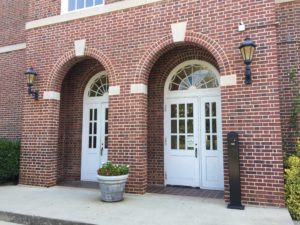 I parked in the almost deserted parking lot just across the street and took a look. Like any place from childhood, Wiley seemed much smaller than I remembered it. I got out of my rental car and crossed the street, pulling out my phone to take a few pictures. The doors I had always gone in from the back were locked, so I walked around to the front to see if the school was opened. I recalled that my art teacher, an excitable man named Mr. Garibaldi or Mr. Grimaldi, had once thrown a chair out of a third-story window right above the spot where I was on the sidewalk, and I glanced up as if I would see a desk rotating through the sky on its way to the ground.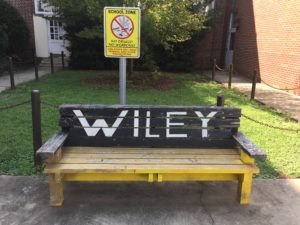
The front door was opened, and I stepped into a narrow foyer and then a larger entrance hall. The black-and-white tile was the same, but the paint was new, as was the library across the hall. There were a few signs in Spanish as well, another sign of change. But then I saw the picture of Mr. Wise, the principal of Wiley from 1968 to 1990, and remembered him immediately. I walked down one hallway, my footsteps echoing off the empty floor–aside from some murmuring in an office down another hallway, the building seemed empty. I stopped and retraced my steps, suddenly unwilling to try and visit an old classroom. I’d seen enough and was more interested in finding my old neighborhood.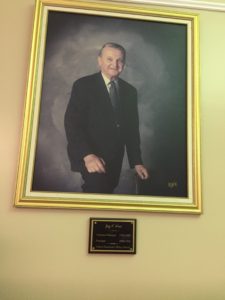
Driving back to Reynolda Road and then turning onto Robinhood, I was bothered by a half-glimpsed memory. Finally I coaxed that memory out into the light, suddenly recalling what Winston-Salem reminded me of. It reminded me of Maycomb, the fictitious town in To Kill a Mockingbird. True, Winston-Salem is much bigger–even as a child I had known that. And I had never known anything like the Great Depression in Winston-Salem. But Maycomb is what I thought of as I drove up Robinhood past Coliseum Drive, which led to Wake Forest University. Perhaps it was because I had been the same age in Winston as Scout had been in Maycomb, or maybe it was because I read To Kill a Mockingbird when I lived there.
And then I hit the light at Buena Vista and turned right, and then I had to pull over. I wasn’t overcome with emotion, exactly. I just needed to pause, awash in memory. I had ridden my bike on these streets, knocked on these doors for candy at Halloween, talked here with the other neighborhood kids about the seminal movies of my generation’s childhood: Star Wars and Raiders of the Lost Ark and E.T. and Jaws. Chip Shealey, my next-door neighbor, was the first to get HBO, and we would go into his basement and watch Jaws on his big cabinet TV, an experience that kept me from swimming alone in my pool from then on, convinced the shark would swim up the drain and eat me. This was where my childhood was.
I drove down the street and then turned right onto Raintree Court. There was Hartley’s ranch house. And Hank and Anna Willis’ white house, and Worth and Caroline Mitchell’s, and Chip Shealey’s, and the Wilsons’ up on the hill. And that was mine at the end of the street. The same green house.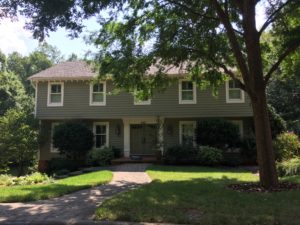
I didn’t get out of the car, just pulled over to the side of the circle and took a picture of my old house and sat there for a minute. Worth Mitchell’s basketball goal was still up on the side of his house above the garage door. How many hours had I played Horse there? How many weekends had I ridden my bike around the cul-de-sac, listening to Casey’s Top Forty on my paperback-sized Walkman? How many days had I spent playing Chase and Army and all sorts of other games in the sprawling woods behind our houses? How many nights had I had friends over and played Dungeons & Dragons and Top Secret and Traveller in my basement or on the patio?
Where had all those things gone?
I drove slowly out of the cul-de-sac, taking a right down Buena Vista for a final pass through the neighborhood. Then I turned around, gave a salute to Raintree Court as I passed it again, and then continued down Buena Vista. I didn’t need to glance at my phone to know that my old elementary school was down this road. And then I came up on it, and when I saw the sign I nearly bumped into the car in front of me. I’d forgotten the name of the school where I’d gone for third and maybe fourth grades, where I’d run the three-legged race in field days and played soccer games and won a quarter betting that the Steelers would beat the Cowboys in Super Bowl XIII.
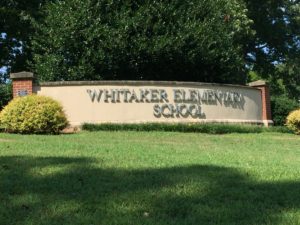 The school’s name was Whitaker Elementary School. Almost twenty-five years after I left that school, my wife and I would name our firstborn son Whitaker. As the Police would sing in a popular album when I was a kid growing up in Winston-Salem: synchronicity.
I snapped a picture of the school sign, then tooled around the streets for another minute or so. I hadn’t gone past Brunson Elementary, where I’d attended for the rest of elementary school before junior high. I hadn’t gone looking for the house where a cute girl in my grade named Sally had lived. I hadn’t gone looking for the candy store where we used to go to buy candy bars and bubblegum with collectible NFL football helmets. But the morning was getting on. So, without fanfare or any sort of gesture of farewell, I went down Buena Vista and turned right onto North Stratford, seeking the highway. It was time to head to Charlotte.
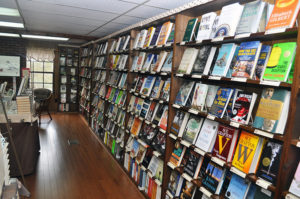
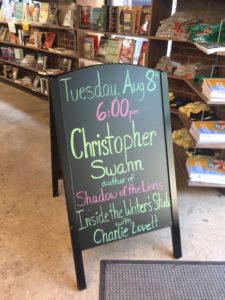 Bookmarks is another interesting independent bookstore. For several years, Bookmarks has been a literary arts organization that puts on a yearly books festival, but this summer they opened a new brick-and-mortar bookstore. It’s non-profit, and Bookmarks supports a variety of things, including an authors in schools program.
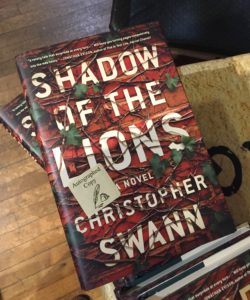
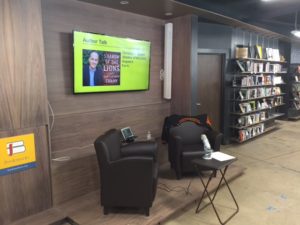 Charlie, himself a Woodberry grad (class of ’80), brought his Woodberry letter jacket and draped it over the back of his chair for our interview. I enjoyed the conversation, although as usual, despite Charlie’s assurances to the contrary, I maybe went on a bit too long in my answers. What was just as enjoyable was talking with folks before and afterwards. Jule Banzet, another Woodberry grad, brought his two sons, one a current fourth or fifth former and the other a hopeful future Tiger. His youngest son approached me afterward as I was signing books and asked me very politely why I had called my book Shadow of the Lions. Not sure I would have been able to do that at his age.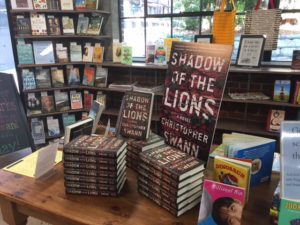
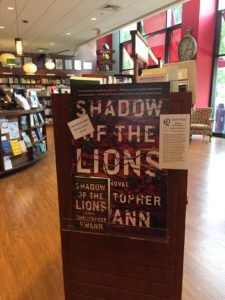
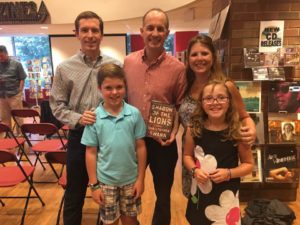 I arrived about fifteen minutes ahead of my event with my cousin Will and his family after we had all gone out for an early dinner. His son and daughter did their best to help sell their dad’s cousin’s book.
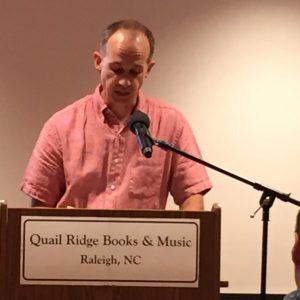 Then I was standing at a microphone in front of a crowd of twenty-five people, all of whom wanted to hear about my book. I read from the prologue, talked a bit about the origins of the story, and said of my protagonist Matthias, “I like characters who make mistakes.” (That last bit got tweeted out by Algonquin via my publicist.) I tried not to ramble, probably did a little bit anyway, but then got into a groove and spoke for maybe half an hour. The Q&A with the audience was interesting. A gentleman asked how I saw the difference between redemption–which I had said my protagonist Matthias was searching for–and salvation. Lynette raised her hand and asked if I had any advice for aspiring authors, which caused her teenage daughter to nearly die from mortification. A lovely young woman who I realized was a former student of mine, Meredith, asked if I had ever, in the middle of teaching class, been struck with an idea to put in my novel.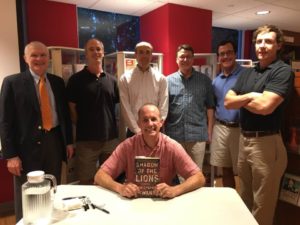
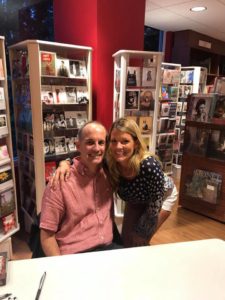
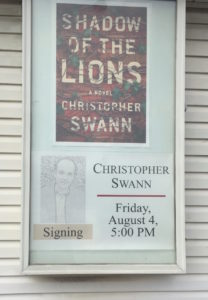
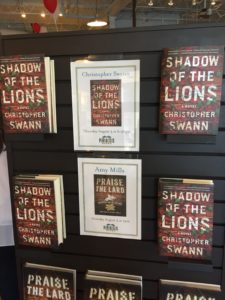
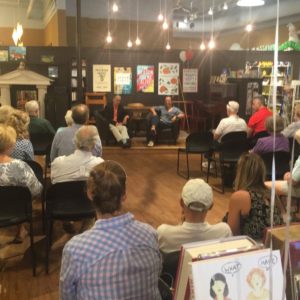 Niki introduced Ed, who introduced me, all to a nice round of applause. We had microphones but elected to ditch them, using our teacher voices to project to the back of the audience. Ed was the quintessential interviewer, displaying his knowledge and understanding of my book but leaving me plenty of room to answer his questions and to elaborate. People laughed politely but sincerely at my jokes. I read the opening two-and-a-half pages of my novel and Ed led the audience in another round of applause. I’ve grown more comfortable talking about my book in the past few days, so it was more than okay. It was fun. The audience asked lots of questions: did I plot out the mystery of Fritz’s disappearance beforehand or let it develop organically as I wrote; do I write for a particular reader or kind of reader in mind; how did I find time to write (short answer: my butt goes in the writing chair for an hour or so after the boys go to bed). Afterwards people bought copies of my book and I signed them, an activity that I still find delightful. Maryanne bought four copies. A third HI alum, Ashley Bahl-Binder, appeared with a hug and a book for me to sign. Never in my life had I thought about how deep and wide the social net of HI alums would be, nor how beneficial it would be for a book-touring English teacher.
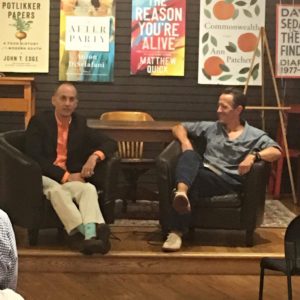 Finally, the customers were all gone, and the Parnassus staff told me it had been a fabulous turnout. Then they asked me almost hesitantly if I would mind signing the rest of their copies. “Gladly,” I said. Ed and Elizabeth-Lee left with their daughters amid promises for Ed and I to get together tomorrow morning for coffee. I really didn’t want to leave, but I knew the staff needed to get home, so I finished signing the books. They also brought me a Moleskine notebook the size of a flatscreen TV as a sort of guest book that visiting authors sign. Their most recent book was full, so I got to be the first to sign in a brand-new one.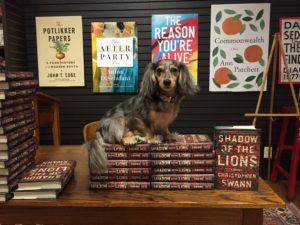
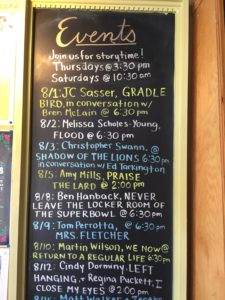
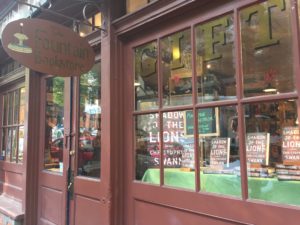
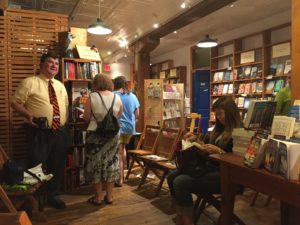
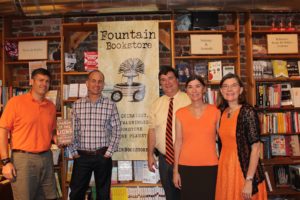
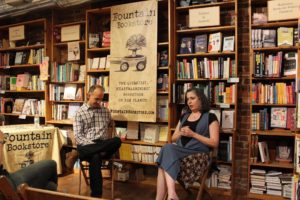 night before, and yet this feels right, more intimate. The customers are attentive and listen as Kelly asks me questions and I try to respond without babbling or wandering off-track. Another former Woodberry classmate, Mike, arrives and waves from the back row. I’m asked about the title, about working under an honor code, how long it took to write the book, did I always assume I was writing a “literary thriller” and what does that mean, which authors inspire me. My former student Katie asks me if being an English teacher helped me in the writing of my own book or if it got in the way. (Yeah, she’s smart.) I answer everyone’s questions and then sign books. My friend Beverly arrives near the end and waits until the store empties. Before everyone leaves I get a picture with the Woodberry folks, and then Kelly has me sign all her remaining copies of my book. Seeing them stacked afterwards with “Autographed Copy” labels on them is yet another realization that this book thing is really happening.