Friday morning I checked out of my hotel in Nashville and drove to Parnassus Books to pick up my signed copy of Bel Canto. (See my previous post for details.) Out of gratitude and solidarity, I purchased a copy of Ann Patchett’s Run, which Niki at Parnassus had recommended. Before I could pay for it, a cashier waved me over to a customer. “This lady is buying a copy of your book,” she said. The customer, who had her young grandson with her, was as delighted to meet the author as the author was to meet her. “I read about this book in the paper,” she said, “and I’m getting it for my book club!” She turned to her grandson and said, “Andrew, this man is the author of this book!” The boy grinned and shook my hand. The copy she had purchased was one I had already signed, but I added a personal note to it. When the customer left, the cashier and I looked at each other and smiled, as if sharing a delightful little secret.
After meeting for coffee with my friend Ed and soaking up some more stories about publishing and book fairs and just being an author in general, I hit the highway for Birmingham. It’s a straight shot due south, and I spent the time listening to music, talking on the phone through the hands-off car system to my wife Kathy, and wondering when I was going to find time to get back to writing book number two.
Algonquin had put me up in two neat boutique hotels so far, and the one in Birmingham, Aloft, did not disappoint either. Imagine a modernist, industrial-looking loft, and that’s what my room looked like, sort of like what I imagine a hotel room in SoHo designed by IKEA would look like. Alabama Booksmith was only an eight-minute walk away, but as it was really hot and humid, I cheated and drove the third of a mile.
Alabama Booksmith is the most unique bookstore I’ve visited yet, starting with Jake, the owner.
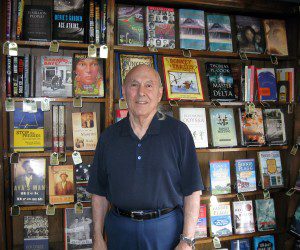
Jake is almost completely bald, his remaining hair pulled back into a frazzled ponytail, but he’s got a lively spirit and a compassionate sense of humor. He met me in the parking lot. “I’m going to ask you the strangest question you’ve ever been asked at a bookstore,” he said. “Is your father’s name David?” Seeing my look of surprise, he continued, “A woman called the store and asked if your father’s name was David, because if so, and if your mother’s name is Nancy, she was in their wedding fifty years ago. She might come in and buy a copy of your book.” We walked up the steps to the front door. “Now, all independent bookstores are weird,” Jake said, “but this is probably the weirdest one you’ve ever been to.”
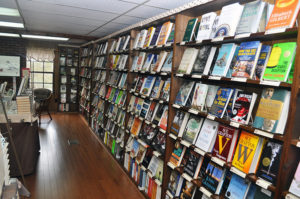
Inside, the store didn’t look weird, although it was empty except for the staff. Every single title faces outward from the shelves so you can see the front cover, and every single copy for sale has been signed by the author. Alabama Booksmith’s big gig is selling signed first editions, which they mail to their enrolled customers. “People don’t really visit this store,” Jake said. “Ninety percent of our customers buy the signed first editions, which we mail to them.”
“So they might come in to the store once, sign up for your program, and they don’t come back?” I asked.
“Exactly!” Jake said, beaming as if he were my teacher and I had just solved a difficult puzzle. “But that one woman in your parents’ wedding called, so we’ll probably get one. If we get two people, that’s wonderful. We don’t really get people who come in to listen to an author.”
Jake led me to a back room where around three hundred copies of my novel sat in stacks on a table. This was why I had come–not to speak with a group of readers, but to sign copies of my book. Alabama Booksmith had selected me as their August choice for their Signed First Edition club. These three hundred books had basically all been sold already–I would sign them, and then the store would ship them out to the members of their club.
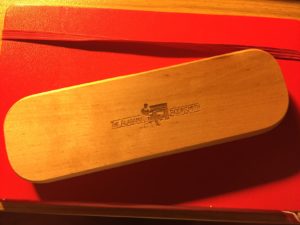
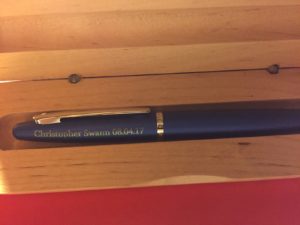
Mike, another bookseller, shot a thirty-second video of me talking about my book, which they assured me was perfectly fine and that I didn’t sound like an idiot. Then, just before the book signing started, Jake placed a thin, narrow box on the table in front of me. “Huh,” he said, faking surprise. I opened the box and found a pen inside. Not just any pen, but one with my name and the day’s date engraved in it. “Well, isn’t that a coincidence?” Jake said, breaking into a smile.
I started signing books. Jake would hand me a book open to the title page, I would sign it, and his partner would take the book from me and place it in a stack, while a fourth staffer would whisk the stack away. About fifty or so copies in, Jake said, “He’s doing pretty good.”
Mike nodded. “Moving right along,” he said.
“He’s no Jimmy Carter, but he’s not bad,” Jake said, then added, “Jimmy Carter can sign a book in four seconds.”
There was an electronic chime–someone had entered the store. Mike raised his eyebrows. “We’ve got a live one,” he said. Another staffer left to greet the visitor. I kept signing books. A minute later, the young staffer returned. “Live one,” he confirmed. Several books later, another chime. Now Jake and Mike looked at each other and then at me. “Two live customers!” Jake said as if he had never seen the like.
I went out into the store and sat at the table set up for me. The table was next to a shelf of signed first editions that were true collector’s items, including a set of Pat Conroy novels, which I felt was a good sign. And it was, because in all, six people came into the store to purchase one or more copies of my book. They all came in separately over the course of the next hour, but they came. Jake was astonished. “This is some kind of record,” he said. Of the six, Jake knew four of them by name. The woman who had been in my parents’ wedding never came, but another friend of my mother’s did.
At the end, Jake took down the poster advertising my visit and promised to mail it to me. Behind the front counter, staff were stacking newly-packaged copies of my book, ready to be mailed out into the world.
Back home to Atlanta for the weekend. Next stop – Raleigh, N.C.!
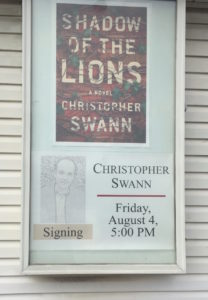
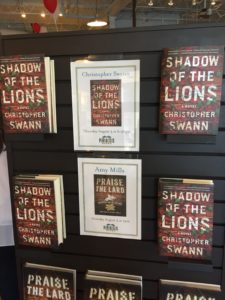
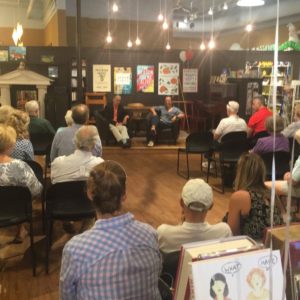 Niki introduced Ed, who introduced me, all to a nice round of applause. We had microphones but elected to ditch them, using our teacher voices to project to the back of the audience. Ed was the quintessential interviewer, displaying his knowledge and understanding of my book but leaving me plenty of room to answer his questions and to elaborate. People laughed politely but sincerely at my jokes. I read the opening two-and-a-half pages of my novel and Ed led the audience in another round of applause. I’ve grown more comfortable talking about my book in the past few days, so it was more than okay. It was fun. The audience asked lots of questions: did I plot out the mystery of Fritz’s disappearance beforehand or let it develop organically as I wrote; do I write for a particular reader or kind of reader in mind; how did I find time to write (short answer: my butt goes in the writing chair for an hour or so after the boys go to bed). Afterwards people bought copies of my book and I signed them, an activity that I still find delightful. Maryanne bought four copies. A third HI alum, Ashley Bahl-Binder, appeared with a hug and a book for me to sign. Never in my life had I thought about how deep and wide the social net of HI alums would be, nor how beneficial it would be for a book-touring English teacher.
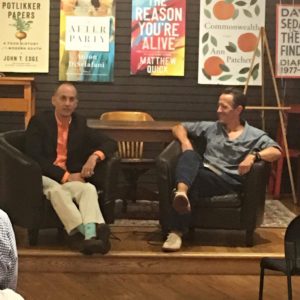 Finally, the customers were all gone, and the Parnassus staff told me it had been a fabulous turnout. Then they asked me almost hesitantly if I would mind signing the rest of their copies. “Gladly,” I said. Ed and Elizabeth-Lee left with their daughters amid promises for Ed and I to get together tomorrow morning for coffee. I really didn’t want to leave, but I knew the staff needed to get home, so I finished signing the books. They also brought me a Moleskine notebook the size of a flatscreen TV as a sort of guest book that visiting authors sign. Their most recent book was full, so I got to be the first to sign in a brand-new one.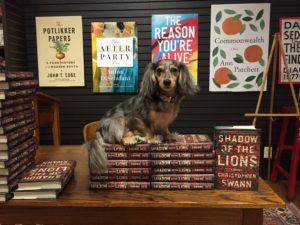
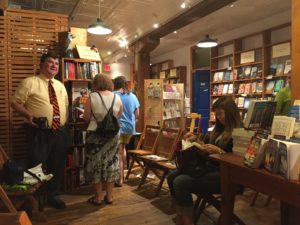
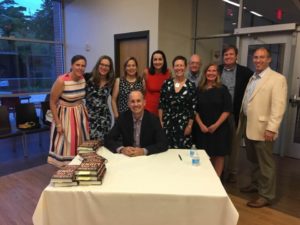
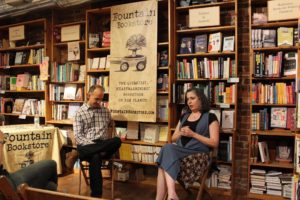 night before, and yet this feels right, more intimate. The customers are attentive and listen as Kelly asks me questions and I try to respond without babbling or wandering off-track. Another former Woodberry classmate, Mike, arrives and waves from the back row. I’m asked about the title, about working under an honor code, how long it took to write the book, did I always assume I was writing a “literary thriller” and what does that mean, which authors inspire me. My former student Katie asks me if being an English teacher helped me in the writing of my own book or if it got in the way. (Yeah, she’s smart.) I answer everyone’s questions and then sign books. My friend Beverly arrives near the end and waits until the store empties. Before everyone leaves I get a picture with the Woodberry folks, and then Kelly has me sign all her remaining copies of my book. Seeing them stacked afterwards with “Autographed Copy” labels on them is yet another realization that this book thing is really happening.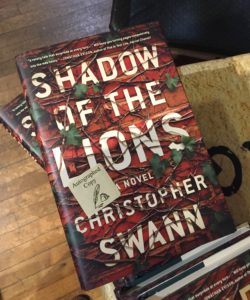
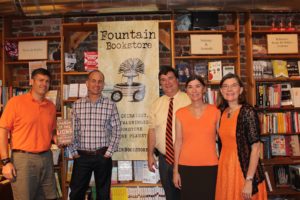
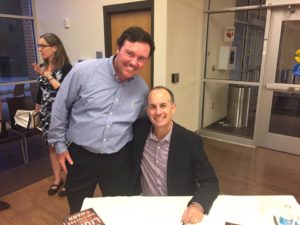
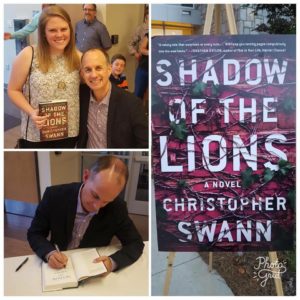
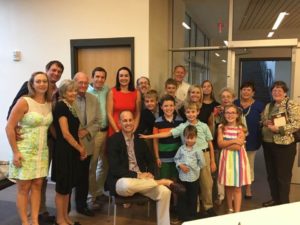
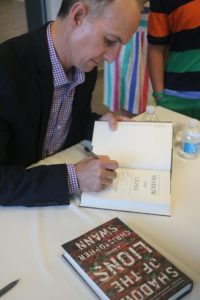 It was like being at my wedding, where I spoke with every single person there, but only for about 2 minutes each. My friend Emily Giffin, a bestselling author and book party pro, came up and told me to move my table — there was a large fire alarm box on the wall behind me, which was right in the sight line of every picture being taken of me. We moved the table and I kept on signing. At one point I started asking everyone how to spell their name because I was afraid I’d misspell them and ruin their books. Carla, a former colleague, came up to hug me, then started brushing my jacket. “You’ve got makeup all over your jacket, Dr. Swann,” she said. “You’ve been hugging women.” Guilty.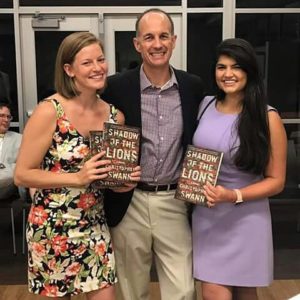
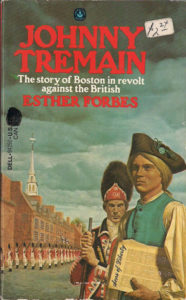 As Mrs. Corpening marched our eighth-grade class into the Revolutionary War, she announced that the unit would culminate in a Project. Everyone at Wiley Junior High knew about the Project. The girls would make patchwork quilts and dolls out of calico and stuffing, and the boys would write a book report on Johnny Tremain. This year, however, Mrs. Corpening presented us with another option that grabbed hold of me by the front of my shirt: we could write a diary—or, for the boys, a journal—from the point of view of a fictitious character living during the Revolutionary War.


