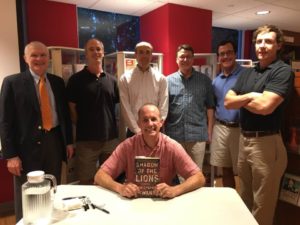
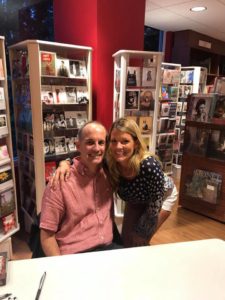
The Townsend Prize for Fiction is Georgia’s most prestigious literary prize, awarded every two years to an outstanding work of fiction by a Georgia writer. Alice Walker, Ha Jin, Ferrol Sams, Terry Kay, and Kathryn Stockett are all past recipients.
Somehow I ended up on the list of ten finalists for this year’s Townsend Prize, so I put on a suit and tie and drove with my wife Kathy to Decatur. I live 9.5 miles from Decatur, and it took us almost an hour and a half to get there, the same amount of time it usually takes me to get to Chattanooga. Gotta love Atlanta traffic. 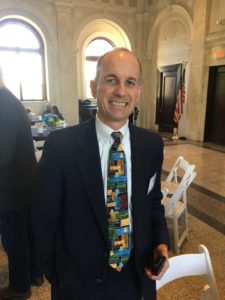
The Townsend Prize ceremony was in the DeKalb History Center, located in the historic courthouse in downtown Decatur. In the lobby, we checked in and got our nametags–mine with a stylized “T” on it, designating me as a finalist–and perused the books on display, all of them written by the ten finalists. Joshilyn Jackson arrived with her husband, and we reintroduced ourselves. Kate Whitman, who works for the Atlanta History Center, arrived shortly afterwards. Kate manages the reading series at the Margaret Mitchell House, where Kathy and I met her last fall when I read there, and she and Kathy instantly took to each other. Anna Schachner, editor of The Chattahoochee Review and one of the MC’s for the evening, stopped to say hello and congratulate me on my nomination. Then Joshilyn corralled us and led the way upstairs to the bar.
Upstairs in what was once the old courtroom, wide windows showed views of downtown Decatur on one side and the skyscrapers of downtown Atlanta on the other. A musical trio warmed up in the corner. Tables were set up throughout the chamber, and there were two separate bars. (Writers.) We got wine and searched for our table, and when we found it we ran into Tom McHaney, a retired GSU professor who, along with his wife Pearl, runs the Georgia Center for the Book. Dr. McHaney served on my dissertation committee, and we chatted about Melville and Faulkner. Kathy and I went to find food and ran into Daren Wang, another Townsend finalist and a friend who was on an extended book tour for his debut, The Hidden Light of Northern Fires.
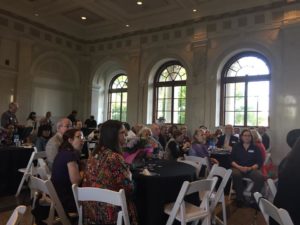 Authors, I’ve found, are typically generous and encouraging souls. I wasn’t disappointed when we finally returned to our table and met some of the other finalists, including Stacia Pelletier, Man Martin, and Jonathan Rabb. All of them were very pleasant and chatty. If they were nervous about the award, they fooled me. Of course we all wanted to win, but I knew I was lucky just to be nominated, and besides, direct competitions between authors feel awkward. Jonathan Rabb and I talked about that, agreeing that it was a bit embarrassing. A young man with neatly slicked-back hair came over from the next table and stuck out his hand and introduced himself as Tom Mullen. He was a Townsend finalist for Lightning Men, the second in his series about the first black police officers in Atlanta in the 1940s and ’50s. He asked if I was local, and after chatting for a few minutes he went to go meet some of the other authors, but not before saying we should get together sometime over coffee.
Then Julia Franks stopped by–we had met at the Berry Fleming Festival in Augusta, where Julia and Daren and I had sat and talked in between sessions, and Julia had been very friendly and kind to me. She had also been a high school English teacher, at Lovett, and I had joked with her about my fear of becoming like the lead character in Mr. Holland’s Opus, the music teacher who composes his orchestral piece for decades while teaching. This night, Julia hugged me and told me she had enjoyed my book very much–“a real page-turner,” she said. “You are the emperor of similes,” she added. I think I’ll print that out and hang it over my desk.
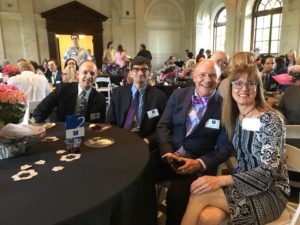 I sat down and finished eating my dinner when my phone dinged–a good luck text from my friend Clarissa, who had given me a Blackburne t-shirt at my launch party. This was followed by another text, this one from Brian Panowich, the author of Bull Mountain, who I had also met in Augusta and who had told me he loved Shadow of the Lions. He wished me luck and added, “Have fun–enjoy the moment.” I showed both texts to Kathy, and suddenly my eyes stung and I had to blink back tears. I’m a high school English teacher who cries at sunsets and supermarket openings, but at this moment I realized that I was now a legitimate author, an honest-to-God novelist, who was drinking wine and rubbing elbows with Georgia literary royalty, as Anna Schachner would later pronounce from the podium.
The evening festivities started with introductions and thank-yous from Joe Davich, followed by Ron Aiken, president of the Atlanta Writers Club. Ron introduced the winner of the AWC scholarship, a young woman who was going to be a journalist. We all clapped and cheered for her, and I remember thinking we really needed people like her in today’s world. Then Anna Schachner got up and, contending with a wonky mic, she introduced Brad Watson, author of Miss Jane and the keynote speaker for the evening. Brad looks like most folks’ idea of what an author looks like, bearded and wearing a sports jacket and looking very slightly rumpled. He held up a printed copy of a speech and said, “I’m throwing this away. It’s no good.” He then went off-script in a meandering, funny speech about how he improbably became a writer, including an attempt to set fire to a box of his own short stories that didn’t quite go as planned. I’m tempted to say that he mumbled, but his articulation was very clear–he just spoke low and softly, and we all leaned in to hear him.
The moment finally came when Brad finished and sat down and Anna got up to announce the winner. All the writers in my line of vision sat up a little straighter, but we were also all smiling. “All the finalists are winners,” Anna said, and although it could sound corny or clichéd, that evening it rang true. I certainly felt like a winner just beig there.
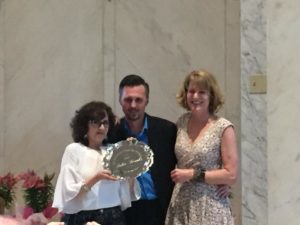 In the end, the lovely Julia Franks won the Townsend Prize for Over the Plain Houses, and everyone cheered. Julia could not find a major publisher to buy her book, and so she went with the smaller Hub City Press in Spartanburg, S.C. We were all thrilled for her. She was perhaps the only one who was astonished that she had managed to win.
The authors all trooped downstairs to mingle and sign books. Daren and I pretended to commiserate at not winning; we had also both learned that day that while we had both made the long list for the Southern Book Prize, we hadn’t made the cut for finalists. Neither of us was feeling a bit sorrowful.
Afterwards, most of us ended up at Leon’s in downtown Decatur, and we had a fabulous time. Daren was treated like the mayor, which makes sense because he essentially is for the literary community in Decatur. Joshilyn took one end of the table and had a big glass of wine to match her big smile. She’s been nominated numerous times for the Townsend and never won, and she seemed perfectly happy with it all. “I’m the Susan Lucci of the Townsend Prize,” she said jokingly. Tom Mullen arrived with his wife, and then Julia Franks arrived to great cheers with Brad Watson in tow. Julia sat next to me, and after I congratulated her I shared with her something I’d heard a group of crime and thriller writers at the Virginia Festival of the Book talk about: most writers seem to get that this isn’t a zero-sum game; if your book does well, that doesn’t mean I lose. Julia said that was exactly right.
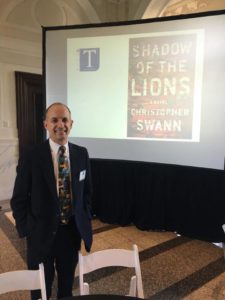 The writers I have met are some of the most generous and supportive people I know. Anna said that all the finalists were winners, and she was right. Julia had not beaten the rest of us; she had rightfully won a prize that celebrates her but also reflects well on all of us. I’m sure there are selfish and catty writers out there, but I want to remain ignorant of them for as long as I can. I’m proud to know these folks, and to be known by them and accepted into their circle. I’ll make sure that if I continue to have success with this writing gig and am ever in a position to welcome and encourage another author, I’ll do it without hesitation. These other authors have done the same for me, and that’s one of the best prizes I could hope to get.

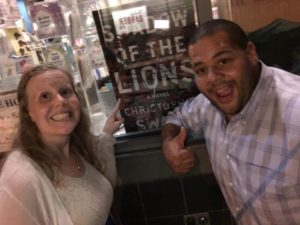
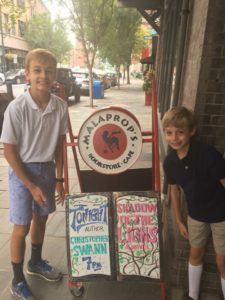 On setting foot inside the store, both boys began roaming the store, peering at shelves. Sullivan wanted the next book in Alan Gratz’s The League of Seven series. Whitaker was drawn to Malaprop’s “blind date” shelf of books wrapped in brown butcher paper. The staff writes a few choice adjectives for the wrapped book on the outside of the paper, and those are the only clues as to what kind of story is hidden beneath the paper. Whitaker carefully chose one, which turned out to be The Madman’s Daughter, a revisioning of H.G. Wells’ The Island of Doctor Moreau.
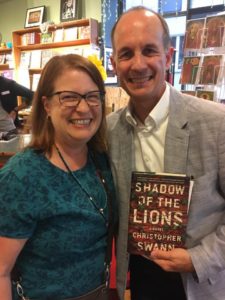 It was Martha, aka SmartyKate, an online friend I had never met before in person. Martha is one of the early members of the Fiction Files, a group launched on MySpace in the early 2000s by author Jonathan Evison. Johnny was just about to publish his first novel, All About Lulu, and the rest of the group consisted of avid readers and hopeful writers.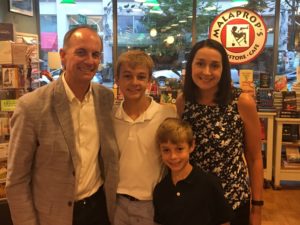
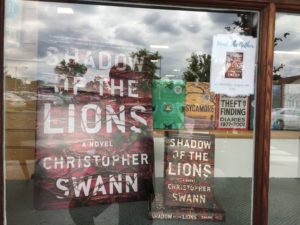
 Park Road Books, located in a nice shopping center in Charlotte, looks relatively nondescript on the outside. Take a closer look through the large bay window–ignore the book on prominent display–and you’ll see something else. The front of the store has a small sitting area, almost like a casual living room with a fireplace. Behind that is the sales counter, and beyond that are the long, narrow alleys of bookshelves.
 I was sort of wandering around in the store half an hour before my event was supposed to start when a vaguely familiar man and his teenage son approached. “Chris Swann?” the man said. “I don’t know if you remember me. William Harris.” Mr. Harris was my ninth-grade Ancient History teacher at Woodberry. I had loved his class. He introduced me to his son, who had just graduated from Woodberry. They now lived in Charlotte, and had a prior dinner engagement, but he had wanted to stop by, get a copy of my book, and get my signature.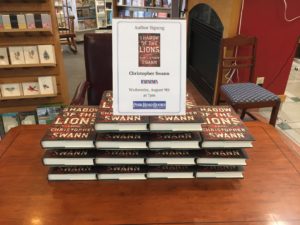
 I parked in the almost deserted parking lot just across the street and took a look. Like any place from childhood, Wiley seemed much smaller than I remembered it. I got out of my rental car and crossed the street, pulling out my phone to take a few pictures. The doors I had always gone in from the back were locked, so I walked around to the front to see if the school was opened. I recalled that my art teacher, an excitable man named Mr. Garibaldi or Mr. Grimaldi, had once thrown a chair out of a third-story window right above the spot where I was on the sidewalk, and I glanced up as if I would see a desk rotating through the sky on its way to the ground.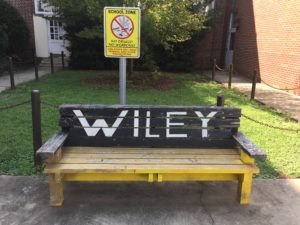

 The school’s name was Whitaker Elementary School. Almost twenty-five years after I left that school, my wife and I would name our firstborn son Whitaker. As the Police would sing in a popular album when I was a kid growing up in Winston-Salem: synchronicity.
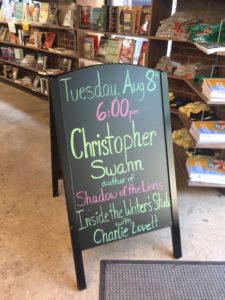 Bookmarks is another interesting independent bookstore. For several years, Bookmarks has been a literary arts organization that puts on a yearly books festival, but this summer they opened a new brick-and-mortar bookstore. It’s non-profit, and Bookmarks supports a variety of things, including an authors in schools program.
 Charlie, himself a Woodberry grad (class of ’80), brought his Woodberry letter jacket and draped it over the back of his chair for our interview. I enjoyed the conversation, although as usual, despite Charlie’s assurances to the contrary, I maybe went on a bit too long in my answers. What was just as enjoyable was talking with folks before and afterwards. Jule Banzet, another Woodberry grad, brought his two sons, one a current fourth or fifth former and the other a hopeful future Tiger. His youngest son approached me afterward as I was signing books and asked me very politely why I had called my book Shadow of the Lions. Not sure I would have been able to do that at his age.

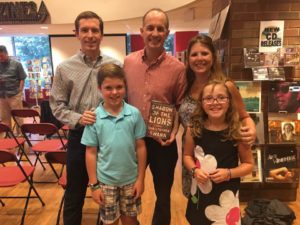 I arrived about fifteen minutes ahead of my event with my cousin Will and his family after we had all gone out for an early dinner. His son and daughter did their best to help sell their dad’s cousin’s book.
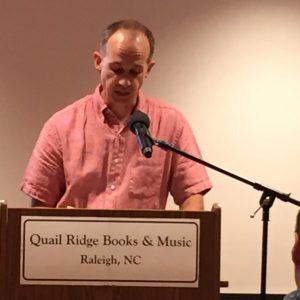 Then I was standing at a microphone in front of a crowd of twenty-five people, all of whom wanted to hear about my book. I read from the prologue, talked a bit about the origins of the story, and said of my protagonist Matthias, “I like characters who make mistakes.” (That last bit got tweeted out by Algonquin via my publicist.) I tried not to ramble, probably did a little bit anyway, but then got into a groove and spoke for maybe half an hour. The Q&A with the audience was interesting. A gentleman asked how I saw the difference between redemption–which I had said my protagonist Matthias was searching for–and salvation. Lynette raised her hand and asked if I had any advice for aspiring authors, which caused her teenage daughter to nearly die from mortification. A lovely young woman who I realized was a former student of mine, Meredith, asked if I had ever, in the middle of teaching class, been struck with an idea to put in my novel.