• Skip to main content
  • Skip to footer

CHRISTOPHER SWANN

Author of NEVER BACK DOWN

  • About
  • Books
    • Myopic Duplicity: A Crime Thriller Anthology
    • Never Back Down
    • Never Go Home
    • Trouble No More: Crime Fiction
    • A Fire in the Night
    • Never Turn Back
    • Shadow of the Lions
  • Blog
    • Why Do We Write? (9/20/25)
    • Every Word Is a Win (6/23/25)
    • The Write Now Podcast (3/19/2024)
    • The best crime fiction that features powerful female characters (7/17/23)
    • Interview with author T. M. Dunn (6/28/2023)
    • Sometimes, We Want Complicated (9/6/2022)
    • Friends & Fiction Fall Season Kickoff (8/17/2022)
    • Friends & Fiction Interview (12/1/2021)
    • Six Great Novels with Mysterious Protagonists (9/10/21)
    • Why I Write About Crime (11/22/20)
    • Novel Number Two (10/5/20)
    • Writing #coronaverse (5/21/20)
    • My First Time Meeting an Author (8/26/19)
    • This is not the America in which I want to live (8/13/2019)
    • WFS 30th Reunion: “Where are the lions?” (7/24/2019)
    • Townsend Prize for Fiction Ceremony (4/19/18)
    • Malaprop’s in Asheville, N.C. (8/10/17)
    • Park Road Books in Charlotte, N.C. (8/9/17)
    • You Can’t Go Home Again? (8/9/17)
    • Bookmarks in Winston-Salem, N.C. (8/8/17)
    • Quail Ridge Books in Raleigh, N.C. (8/7/17)
    • Alabama Booksmith in Homewood, AL (8/4/17)
    • Parnassus Books in Nashville, TN (8/3/17)
    • Fountain Bookstore in Richmond, VA (8/2/17)
    • Book Launch for SHADOW OF THE LIONS (8/1/17)
    • Write What You Know, With a Vengeance (5/14/17)
  • Events
  • Editorial Services
  • Contact

Christopher Swann

My First Time Meeting an Author

August 26, 2019 by Christopher Swann

(Thanks to friend and fellow author David Abrams (go read his book BRAVE DEEDS) for posting this piece I wrote on his blog The Quivering Pen.)

When I was an undergraduate student at Washington and Lee, the author Richard Ford visited campus. I had read his short story “Rock Springs” and his most recent novel at the time, The Sportswriter, and I vaguely understood that he was a Serious American Author, an up-and-coming big deal in the world of American literary fiction. One of my professors, Jim Warren, invited me and another creative writing student, Traci Lazenby, to dinner with Richard Ford. Moreover, we would each submit a piece of writing for Ford to read, and he would give us feedback in a subsequent one-on-one workshop with him the next day. 

We had dinner at one of the fancier restaurants in Lexington, Virginia, the kind of place you only went to when your parents were in town and could take you out to dinner. Richard Ford was wearing khakis and a white shirt and a dark tie and a lived-in blazer, the kind he probably wore when he sat down at his typewriter and pushed his sleeves back to the elbows before writing. I immediately regretted my own blazer, which had brass buttons and made me look, I was certain, like a little boy going to church for the first time. I remember Ford asked the waitress for a Bombay and tonic. This made an impression on me because my dad drank gin and tonics, and Bombay was his preferred gin. However, the waitress didn’t know what Bombay was, and Ford had to explain it to her. The waitress went to the bar but returned and said she was sorry, they didn’t have Bombay, but they had Tanqueray. Ford politely said that would be fine. I don’t remember much else about the dinner, except that Richard Ford epitomized East Coast cool while I mostly remained mute because I was afraid I’d make a fool of myself. 

The next day I met Richard Ford in an empty classroom in Payne Hall—the House of Payne, we called it. I was nervous because this was the first time an actual, serious author who was not my instructor was going to read and evaluate my writing.

I was also nervous because no one else had read what I had sent to the celebrated author for his feedback. It was the opening chapter to a novel I’d begun about a college student, a frat guy, who likes to party and cruises on his smarts but secretly wants to be a writer, except he’s afraid to admit it. There was a James Earl Jones-like instructor, Professor Worthington, and a beautiful girl, a poet in the same creative writing class as the protagonist. The title of this tour de force was Wasted Time. (No one is more certain of his own cleverness than a college undergraduate.) 

Richard Ford wore the same blazer he’d worn the night before, although he had shed the tie and, I assumed, was wearing a different shirt and khakis. He greeted me and shook my hand, but he seemed a little out of sorts as he sat there looking at me. He asked me which contemporary authors I liked to read. I froze. I was into Shakespeare and Chaucer and medieval literature. Contemporary? Every title of every contemporary novel I’d ever read vanished from my mind. Ford sat there patiently. If I said “Richard Ford,” I’d look like the worst kind of sycophant. Then a memory dropped like a bright penny: my high school English teacher had assigned Jay McInerney’s Bright Lights, Big City, which I had liked, so I said that. Richard Ford raised his eyebrows in surprise, and we chatted about Bright Lights, Big City for a minute. “I can’t believe we’re talking about Jay’s book,” Richard Ford said.

Jay’s book, I thought. He was on a first-name basis with Jay McInerney. It was like a hidden door to the world of authors had been opened. This was the real deal. And I wanted in. I wanted to write novels and to wear a lived-in blazer and to be able to say casually, some day, to a would-be writer, “Oh, you read Richard Ford’s book? Yeah, Rick and I were tossing back Bombay and tonics just last weekend. I can’t believe we’re talking about old Rick’s book.” 

Then Richard Ford picked up the pages I had sent him to read and sort of looked at them, like there was something he wanted to say but he’d lost it in those pages. He leafed through them, then put the pages down and started talking. I don’t know what he said, because when he’d put the pages down, the last page was on top, and so I could read Richard Ford’s handwritten note on that last page. What he had written was, A really bad story. 

Ford continued to talk, and somehow, through my embarrassment and basement-level self-esteem, I understood that he was talking about why my short story wasn’t working. When he paused to take a breath, I rushed into the opening. “This isn’t a short story,” I said. 

“It’s not?” he said. 

“No, sir,” I said. “It’s meant to be the opening chapter of a novel.” 

“Oh,” he said, then looked down at the comment he’d written on the back page, A really bad story. He picked up a pen and reached over and crossed out the word really. 

In the past, when I’ve shared this story, I’ve usually stopped there. I get to shrug and smile ruefully while my listeners laugh, and unlike real life that anecdote has a definitive zinger of an ending. 

What actually happened was that, after a moment or two of looking down at my pages while I tried not to die of mortification, Richard Ford reached over again with his pen and crossed out the entire comment. He looked relieved, although nowhere near as relieved as I felt. And then he talked with me about the difference between short stories and novels, how to lay out a long narrative and use the opening to set up characters and conflicts. 

I walked away from that meeting with a profound sense of relief that I had escaped unscathed. It was only much later that I came to appreciate what Richard Ford had done. He had shared his honest opinion of my writing, something all writers need to hear. When he learned that what I had written wasn’t a short story but the opening of a novel, he re-evaluated his opinion on the fly and offered his thoughts on how to approach writing novels. More than anything else, Richard Ford treated me seriously, as someone who wanted to write well and needed guidance on how to do so. He initiated me into the fellowship of writers. 

In my long career as a high school teacher, I have met several students who want to write, all of them eager and anxious, all of them wanting to know if they are any good. An unthoughtful critique or a dismissive word from a teacher could be devastating. Richard Ford was kind enough to be both honest and encouraging, and so I hope to be able to pay that forward, to offer candid and supportive feedback, to help a young would-be writer think that he or she just might be able to do this after all. 
Filed Under: POSTS

This is not the America in which I want to live

August 13, 2019 by Christopher Swann

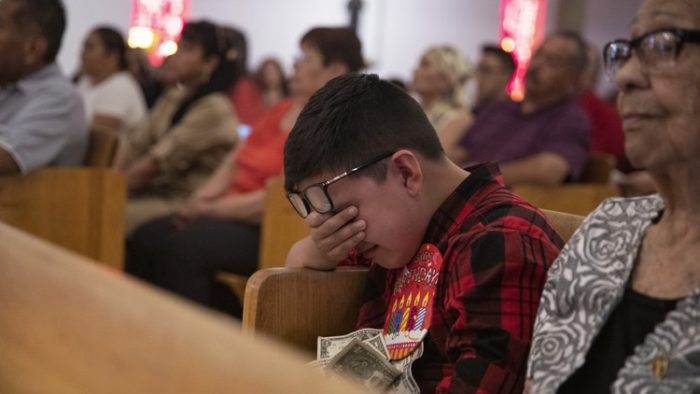
Thomas Ledesma cries during a Mass honoring the victims of the El Paso mass shooting,
at El Buen Pastor Mission on the outskirts of El Paso, Texas, on Sunday, Aug. 11, 2019.
Photo: CALLA KESSLER/NYT

(On Monday, August 5, 2019, I walked into the school where I have taught for nearly twenty-five years and had a moment of crisis. I wrote about it on my Facebook page, then had the great good fortune to get it published on the Atlanta Journal-Constitution‘s “Get Schooled” blog. I’ve posted the piece below. If you like my essay, this one by high school student Emily Ross is even better.)

This morning, at 7:15, summer officially ended.

I walked up the stairs from the parking lot underneath my classroom building where I work. This will be my 24th year of teaching at this school, my 24th year of walking into an empty classroom, excited and nervous in anticipation of the students who will soon crowd the halls.

It was a beautiful morning in Atlanta, 72 degrees, slightly overcast, the humidity holding off for the moment. The sun was coming up, a rosy glow lighting the sky behind the Baptist church across the street. It’s a sight I have seen hundreds of times, and it usually steadies me, puts me in a good mood as I contemplate the lesson I’m going to teach or the colleagues and students I’m going to meet.

This morning was different. This morning, I didn’t see possibility, or potential, or promise.

This morning, I saw lines of fire.

I saw escape routes.

I saw targets.

Two mass shootings occurred within 13 hours of each other, one in El Paso, Texas, and one in Dayton, Ohio. This morning on NPR, David Greene was speaking with the mayor of El Paso, Dee Margo. Mayor Margo was plain-spoken with a Texas drawl, exactly like you’d expect a movie cowboy to sound. He spoke of resolve, but he also sounded at a bit of a loss. He didn’t know how he was going to prepare for the 22 funerals of shooting victims that would take place in the coming weeks.

When he spoke of meeting the 2-month-old child whose mother had died while reportedly shielding him from gunfire, and then added that this boy had also lost his father in the attack, I had to turn my radio off.

I walked up the stairs from the parking lot with tears in my eyes. And I looked at the space between two classroom buildings and saw it not as a place where students often congregate between classes, or a place I cross at least once a day to go get a cup of coffee or to check my faculty mailbox.

Instead, I saw it as a place where shooters could target students and teachers. Wide open. Vulnerable. I found myself almost unconsciously looking for where I could run, where I could try to hide in case someone opened fire.

Not half an hour earlier, I dropped my youngest son off at the school track for his first middle school cross country practice. “Wait,” he said as he got out of the car. “I don’t know where to go.”

“Go where you see other students,” I said. “A coach.”

He said okay and headed off, water bottle in hand.

What trust. How innocent. Go over with the other students, buddy. There’s a coach over there. It’s fine. You’re safe.

But he’s not.

We’re not.

Not completely.

I know not everyone is completely safe all the time from any possible harm.

But now every time I go to a public gathering, I look for the exits, not for the sake of convenience but because I want to know where I should go if someone starts shooting.

Far too often, when I walk into work I wonder if today is the day some hateful man with a gun decides to vent his frustration and anger at my school.

Both I and my sons have experienced school lockdowns that were not drills. When I was on lockdown at my school with a room full of seniors and someone pounded on the door and tried to force it open, I thought for a handful of seconds that I would die in my classroom.

When my oldest son was on lockdown at his school, he texted me and my wife from where he and his classmates were hiding to tell us what was happening, and that he loved us.

This cannot stand.

We can’t allow it to stand.

We are better than this.

We are better than politics.

We defeated the Nazis and cured polio and sent men to the moon half a century ago. We can solve this.

Many of you will be tempted to argue about gun control, to say that the 2nd Amendment is sacrosanct, that it’s not guns that kill but people, that this or that measure wouldn’t have stopped a particular shooter or a specific instance of gun violence, that criminals won’t obey laws so laws about guns are useless. Or you might want to argue that this is about mental health, or violent video games, or a soul-sick society.

But the men who commit these acts of gun violence are not all mentally ill. They are filled with hate. Many are racist. Many express fear about immigrants, or non-whites, or non-Christians. And instead of just posting rants on 8chan or arguing online or attending white supremacist rallies, they buy easily obtainable firearms and set out to commit murder.

This has to stop.

Because we have done nothing substantive to stop it.

And some of our elected representatives have actively stood in the way of doing something substantive to stop it.

Running roughshod over Constitutional rights is not what I’m talking about.

But your individual right to purchase a firearm with little to no regulation should not override my individual right to exist in relative peace and safety.

Let’s talk about how to do this. Let’s talk about how to regulate firearms the way we regulate automobiles, for example. Let’s have our elected representatives actually debate this in public, commission the CDC or some other non-partisan group to study gun violence and ways to stem it.

This really isn’t political. Or it shouldn’t be.

It’s personal.

It’s because I don’t want to hear about thoughts and prayers offered up instead of concrete, deliberate action.

It’s because I don’t want to hear any more stories about shoppers being shot to death at Walmart, about people dying in a hail of bullets at a nightclub, about children being gunned down at school.

It’s because I no longer want to walk into my place of work, a place that I love, and imagine all the ways someone with a gun might kill me, or my students, or my own children.

This is not the America in which I want to live.

Filed Under: POSTS

WFS 30th Reunion: “Where are the lions?”

July 24, 2019 by Christopher Swann

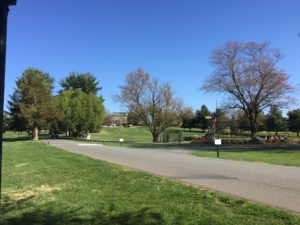
The drive up to Woodberry, similar to the drive up to the Hill at Blackburne in my novel.

In April of 2018, I returned to Woodberry Forest School in Virginia for my thirtieth high-school reunion. I had some of the same feelings that I assume most people have when attending such a reunion: excitement, nostalgia, trepidation. My classmates had seen some of my best and worst moments in life; they literally saw me grow up from an awkward, metal-mouthed kid to a somewhat less-awkward young man. On top of that, we all lived with each other for nine months out of the year. Put 350 teenaged boys on a hill in rural Virginia and you’ll understand why Lord of the Flies could happen.

However, I was apprehensive about this particular reunion for a reason most people don’t have. The previous fall, I had published a novel set in a boarding school with more than a passing resemblance to Woodberry, with characters who bore the first or last names of some of my own classmates. Woodberry Forest had been very supportive of me and Shadow of the Lions, writing a nice article for their website and inviting me to participate in a panel discussion during my reunion visit. I had been contacted by classmates who praised the book and congratulated me.

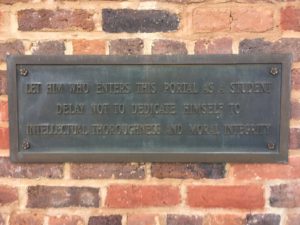
“Let him who enters this portal as a student delay not to dedicate himself to intellectual thoroughness and moral integrity.”

But actually returning to Woodberry felt a bit like returning to the scene of a crime. The events in Shadow of the Lions are almost entirely fictionalized; I know of no crimes that took place during my time at Woodberry, and my roommate never disappeared as Fritz Davenport does in my novel. My novel is not an exposé of Woodberry. But it does draw on my experience of living and going to school at Woodberry for four of the most formative years of my life. How would my classmates and former teachers react?

Amazingly, it turned out.

The class of 1988 had a good turnout. The Friday we arrived, there was a reception for alumni under a tent behind the headmaster’s house. I greeted and was greeted by people I hadn’t seen since graduation. Everyone seemed to know about the novel, in part because my friend and Woodberry roommate for three years, Matthew Middelthon, had proudly told everyone about it. Everyone shook my hand and smiled and clapped me on the shoulder and said they’d loved the book or they hadn’t read it yet but planned to.

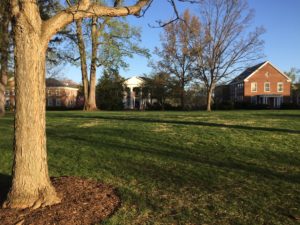
Woodberry campus

The night was cool but clear, and I stood under the tent with a beer in my hand, looking at the strung lights and knots of people at the hors-d’oeuvres table or the bar. I was struck then by the oddest sense of déjà-vu: near the end of Shadow of the Lions, the protagonist Matthias Glass attends his tenth-year reunion at Blackburne, under a tent strung with lights. A classmate saw me staring around the tent and asked if I was okay. I waved an arm at the scene in front of me, trying to encompass everything, and gave him a goofy smile. “It’s just . . . this is just like a scene in my book,” I said. He grinned and clinked his beer bottle against mine.

The next day, Saturday, was pleasantly surreal. A few weeks earlier, my AP English teacher from Woodberry, Ted Blain, had e-mailed me with a special request. His fifth-form or junior students were reading Shadow of the Lions for his class, he told me, and they were about two-thirds of the way through. They were enjoying it and wanted to talk with the author and ask me some questions. The problem was that they did not meet as a class on Saturdays, but Mr. Blain had worked out a half-hour block of time when the majority of his students would be free. Would that work?

Let me get this straight, I thought. My former English teacher, a role model for me in my own career as a high-school teacher, is teaching my novel to his current students, and they’d like to meet with me to talk about the book and ask me some questions. Yeah, I think I could swing that. That’s not what I wrote Mr. Blain in response–I basically said yes, thank you, that would be wonderful–but I think he understood.

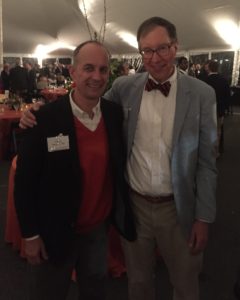
Me and Ted Blain

So I met with several junior boys at 11am on Saturday morning in my old English classroom, with my former English teacher looking on. My friend Matthew insisted on coming and sat in the corner. The half hour stretched to forty-five minutes or so, and it was delightful. The students were polite and insightful and asked all kinds of good questions, and I can only hope my answers didn’t sound canned or pompous.

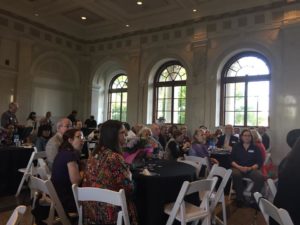
That afternoon, Woodberry scheduled an author round table discussion with myself; Jon Buchan ’68, author of Code of the Forest; and Mr. Blain, who had written two murder mysteries. After having gone on the road to support my novel, I knew that any sort of public reading or discussion was a “fingers-crossed” event, where the attendance might be fifty people, or five, or two. Most of my classmates showed up, along with some of Jon’s as well and a few Woodberry staff members.

Jon Buchan ’68, me, Ted Blain

Boarding school was not easy. I did relatively well in school and enjoyed the academic challenge, most of the time, and I made some good lifelong friends. But I was a dorky teenager and not very good at the give-and-take verbal banter that is the daily bread-and-butter of teenage life. I was always thinking of great responses five minutes later. I was friendly with most of my fellow students, but I only had a few friends I would call close. Boarding school was an amazing and formative experience, but it was not always pleasant, and I cried my share of frustrated tears, wondering why some of my classmates seemed to tease me mercilessly. Looking back on those years, I can see that it wasn’t much more than the usual kind of sparring that teenagers have engaged in since teenagers were invented, but at the time it just felt cruel.

Jim Cooper ’88, me, Andy McGuire ’88, Matthew Middelthon ’88

Sitting at that author round table and looking out at my classmates, who all had other things they could have been doing on a sunny Saturday afternoon at their high school reunion, I felt like, after a long absence, I had just come home. They asked questions and clapped and cheered, and then they brought me copies of my book to sign for them. One classmate said he loved the Easter eggs I had sprinkled throughout the novel, referencing people and places my classmates all recognized. Another asked if he was in the book, and if so, what happened to him. People often talk about the bonds formed among boarding school classmates, and all I can say is that, for me, those bonds are real.

But my favorite question of the afternoon was from a classmate I hadn’t seen for thirty years.
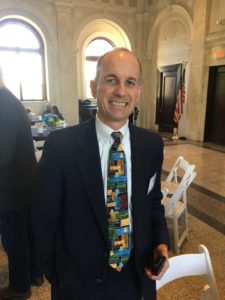
In Shadow of the Lions, the opening scene takes place at the front entrance to Blackburne, where the drive is flanked by two brick columns, each topped by a stone lion, the school mascot. Those stone lions are referenced throughout the novel.

This classmate of mine plunked down a copy of Shadow of the Lions for me to sign. As I started to sign it for him, he said, “Hey, Swanny, I have a question. Where are the lions?”

I looked up at him. “What do you mean?”

“The lions,” he said. “The stone lions, you know? I’ve been looking for them.”

“The ones in my book?”

“Yeah,” he said. “What happened to them? Did they take them out or what?”

Finally I understood. He had been looking around Woodberry’s campus for the stone lions. “Dude, I made them up,” I said. “We’re the Woodberry Tigers. There aren’t any lions.”

He looked surprised, then irritated, and then he burst into laughter. “That’s a good one,” he said, like I’d just played a trick on him and he admired how I’d done it.

That might be the best review my novel has received.

Filed Under: POSTS

Townsend Prize for Fiction Ceremony

April 23, 2018 by Christopher Swann

The Townsend Prize for Fiction is Georgia’s most prestigious literary prize, awarded every two years to an outstanding work of fiction by a Georgia writer.  Alice Walker, Ha Jin, Ferrol Sams, Terry Kay, and Kathryn Stockett are all past recipients.

Somehow I ended up on the list of ten finalists for this year’s Townsend Prize, so I put on a suit and tie and drove with my wife Kathy to Decatur.  I live 9.5 miles from Decatur, and it took us almost an hour and a half to get there, the same amount of time it usually takes me to get to Chattanooga. Gotta love Atlanta traffic. 

The Townsend Prize ceremony was in the DeKalb History Center, located in the historic courthouse in downtown Decatur. In the lobby, we checked in and got our nametags–mine with a stylized “T” on it, designating me as a finalist–and perused the books on display, all of them written by the ten finalists. Joshilyn Jackson arrived with her husband, and we reintroduced ourselves.  Kate Whitman, who works for the Atlanta History Center, arrived shortly afterwards. Kate manages the reading series at the Margaret Mitchell House, where Kathy and I met her last fall when I read there, and she and Kathy instantly took to each other. Anna Schachner, editor of The Chattahoochee Review and one of the MC’s for the evening, stopped to say hello and congratulate me on my nomination. Then Joshilyn corralled us and led the way upstairs to the bar.

Upstairs in what was once the old courtroom, wide windows showed views of downtown Decatur on one side and the skyscrapers of downtown Atlanta on the other. A musical trio warmed up in the corner. Tables were set up throughout the chamber, and there were two separate bars. (Writers.) We got wine and searched for our table, and when we found it we ran into Tom McHaney, a retired GSU professor who, along with his wife Pearl, runs the Georgia Center for the Book. Dr. McHaney served on my dissertation committee, and we chatted about Melville and Faulkner. Kathy and I went to find food and ran into Daren Wang, another Townsend finalist and a friend who was on an extended book tour for his debut, The Hidden Light of Northern Fires.

Authors, I’ve found, are typically generous and encouraging souls. I wasn’t disappointed when we finally returned to our table and met some of the other finalists, including Stacia Pelletier, Man Martin, and Jonathan Rabb.  All of them were very pleasant and chatty. If they were nervous about the award, they fooled me. Of course we all wanted to win, but I knew I was lucky just to be nominated, and besides, direct competitions between authors feel awkward.  Jonathan Rabb and I talked about that, agreeing that it was a bit embarrassing. A young man with neatly slicked-back hair came over from the next table and stuck out his hand and introduced himself as Tom Mullen.  He was a Townsend finalist for Lightning Men, the second in his series about the first black police officers in Atlanta in the 1940s and ’50s.  He asked if I was local, and after chatting for a few minutes he went to go meet some of the other authors, but not before saying we should get together sometime over coffee.
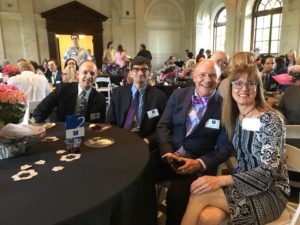
Then Julia Franks stopped by–we had met at the Berry Fleming Festival in Augusta, where Julia and Daren and I had sat and talked in between sessions, and Julia had been very friendly and kind to me. She had also been a high school English teacher, at Lovett, and I had joked with her about my fear of becoming like the lead character in Mr. Holland’s Opus, the music teacher who composes his orchestral piece for decades while teaching. This night, Julia hugged me and told me she had enjoyed my book very much–“a real page-turner,” she said. “You are the emperor of similes,” she added.  I think I’ll print that out and hang it over my desk.

I sat down and finished eating my dinner when my phone dinged–a good luck text from my friend Clarissa, who had given me a Blackburne t-shirt at my launch party.  This was followed by another text, this one from Brian Panowich, the author of Bull Mountain, who I had also met in Augusta and who had told me he loved Shadow of the Lions.  He wished me luck and added, “Have fun–enjoy the moment.” I showed both texts to Kathy, and suddenly my eyes stung and I had to blink back tears.  I’m a high school English teacher who cries at sunsets and supermarket openings, but at this moment I realized that I was now a legitimate author, an honest-to-God novelist, who was drinking wine and rubbing elbows with Georgia literary royalty, as Anna Schachner would later pronounce from the podium.
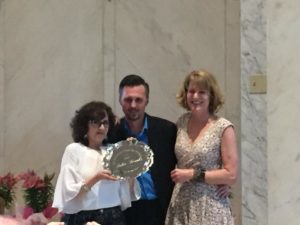
The evening festivities started with introductions and thank-yous from Joe Davich, followed by Ron Aiken, president of the Atlanta Writers Club.  Ron introduced the winner of the AWC scholarship, a young woman who was going to be a journalist.  We all clapped and cheered for her, and I remember thinking we really needed people like her in today’s world.  Then Anna Schachner got up and, contending with a wonky mic, she introduced Brad Watson, author of Miss Jane and the keynote speaker for the evening.  Brad looks like most folks’ idea of what an author looks like, bearded and wearing a sports jacket and looking very slightly rumpled.  He held up a printed copy of a speech and said, “I’m throwing this away.  It’s no good.”  He then went off-script in a meandering, funny speech about how he improbably became a writer, including an attempt to set fire to a box of his own short stories that didn’t quite go as planned.  I’m tempted to say that he mumbled, but his articulation was very clear–he just spoke low and softly, and we all leaned in to hear him.

The moment finally came when Brad finished and sat down and Anna got up to announce the winner.  All the writers in my line of vision sat up a little straighter, but we were also all smiling. “All the finalists are winners,” Anna said, and although it could sound corny or clichéd, that evening it rang true.  I certainly felt like a winner just beig there.

In the end, the lovely Julia Franks won the Townsend Prize for Over the Plain Houses, and everyone cheered. Julia could not find a major publisher to buy her book, and so she went with the smaller Hub City Press in Spartanburg, S.C. We were all thrilled for her. She was perhaps the only one who was astonished that she had managed to win.
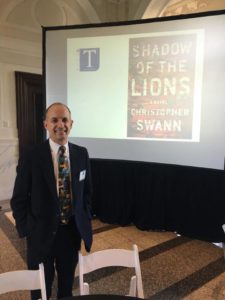
The authors all trooped downstairs to mingle and sign books. Daren and I pretended to commiserate at not winning; we had also both learned that day that while we had both made the long list for the Southern Book Prize, we hadn’t made the cut for finalists.  Neither of us was feeling a bit sorrowful.

Afterwards, most of us ended up at Leon’s in downtown Decatur, and we had a fabulous time. Daren was treated like the mayor, which makes sense because he essentially is for the literary community in Decatur.  Joshilyn took one end of the table and had a big glass of wine to match her big smile.  She’s been nominated numerous times for the Townsend and never won, and she seemed perfectly happy with it all.  “I’m the Susan Lucci of the Townsend Prize,” she said jokingly.  Tom Mullen arrived with his wife, and then Julia Franks arrived to great cheers with Brad Watson in tow.  Julia sat next to me, and after I congratulated her I shared with her something I’d heard a group of crime and thriller writers at the Virginia Festival of the Book talk about: most writers seem to get that this isn’t a zero-sum game; if your book does well, that doesn’t mean I lose. Julia said that was exactly right.

The writers I have met are some of the most generous and supportive people I know. Anna said that all the finalists were winners, and she was right. Julia had not beaten the rest of us; she had rightfully won a prize that celebrates her but also reflects well on all of us.  I’m sure there are selfish and catty writers out there, but I want to remain ignorant of them for as long as I can.  I’m proud to know these folks, and to be known by them and accepted into their circle.  I’ll make sure that if I continue to have success with this writing gig and am ever in a position to welcome and encourage another author, I’ll do it without hesitation. These other authors have done the same for me, and that’s one of the best prizes I could hope to get.

Filed Under: POSTS

Malaprop’s in Asheville, N.C.

August 25, 2017 by Christopher Swann

When I was a teenager living in Asheville, downtown was empty. I can imagine tumbleweeds rolling down the streets. There was the bank where my father worked; the Civic Center; a single upscale restaurant, 23 Page; a few X-rated theaters that my mother forbade me to enter; and a whole bunch of office windows with “To Let” or “For Rent” signs in them.

If you have been to Asheville anytime over the past ten years, you know that now it looks more like this:

Courtesy of: RomanticAsheville.com

Asheville is now hopping with art galleries, restaurants, shops, breweries, wine bars, and festivals. That has its own problems, such as crowds and parking, but overall I’d much rather have downtown Asheville like this than have it remain the wasteland it was in the mid-to-late 1980s.

Malaprop’s was one of the first stores to usher in the new era. While it began in 1982 and developed a core following, it wasn’t until it moved to its current location in 1997 that it became one of the premier independent bookstores in the South, if not the United States. (You can read about its humble beginnings and goals here.)

My family moved to Atlanta in 1988, and while I have a vague memory of possibly going to Malaprop’s at its old location, I didn’t make a proper visit to its new location until well into the 21st century. I’d heard of it, of course. But the store is truly a delightful place. I’ve been a handful of times over the past few years, and each time feels a bit like a pilgrimage. It has the same sort of feng shui of most indie bookstores, striking a balance between crowded and comfortable–a sort of cozy atmosphere, where everywhere you turn there are books but there are also enough places where a customer can have a private moment alone with an old or new favorite book.

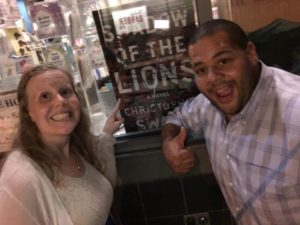
I’d been growing more excited about going to Malaprop’s as an actual author since two friends of mine, Claire and Quinton, posted this picture on Facebook on July 1 with the caption “Guess what we spotted in a bookstore window in Asheville tonight!!!”

This was the first time someone had spotted a notice about my book in an actual bookstore.

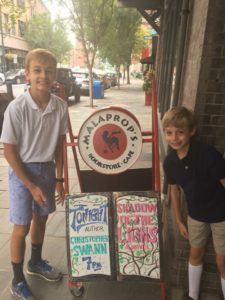
The night of my reading at Malaprop’s, I was joined by my wife Kathy, who had driven up from Atlanta, and our sons Whitaker and Sullivan, who had been spending the past two weeks with my parents in Asheville. We arrived at Malaprop’s about an hour ahead of time, which allowed us to get a picture of both boys with the sign outside of the store. On setting foot inside the store, both boys began roaming the store, peering at shelves. Sullivan wanted the next book in Alan Gratz’s The League of Seven series. Whitaker was drawn to Malaprop’s “blind date” shelf of books wrapped in brown butcher paper. The staff writes a few choice adjectives for the wrapped book on the outside of the paper, and those are the only clues as to what kind of story is hidden beneath the paper. Whitaker carefully chose one, which turned out to be The Madman’s Daughter, a revisioning of H.G. Wells’ The Island of Doctor Moreau.
I was a little jealous, watching both boys. I wanted to wander around the bookstore and discover a new book. Instead, I was preparing to talk about my own book, with not a few butterflies in my stomach.

Understand that I’m not complaining. I’d been dreaming of writing a novel since I was in eighth grade. This was, quite literally, part of a lifelong dream coming true. But now I was going to do my dog-and-pony show in front of my parents and their friends, some of whom had known me since I was a teenager. And my throat was a little sore. That was all I needed, to lose my voice. Fortunately the café served a lemon-infused camomile tea that I dosed with honey, which did wonders.

Jacob, one of the store staff, was setting out about a dozen folding chairs. “Jacob,” Kathy said, shaking her head in mock disappointment, “we’re going to need a lot more chairs.”

I laughed, then felt the butterflies come back. How many people were going to come? Would the store be packed? Would no one come at all? Which would be worse?

Then my parents arrived, followed soon by my godparents Croom and Meriwether. Before I knew it, I was shaking hands with many more of my parents’ friends and introducing Kathy. Then a tall man hove into view with a familiar, easy smile. It was Kirk Duncan, my former head of school and now head of Carolina Day School in Asheville. Somehow seeing Kirk set me at ease.

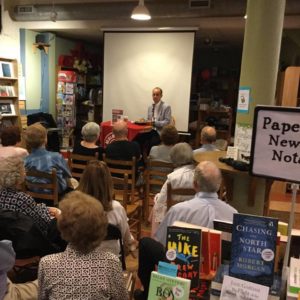
Before I knew it, Jacob had me sitting on a stool at the front of the seated crowd–while the store wasn’t technically packed, it was a close thing–and adjusted a microphone on a stand so it hovered right in front of my mouth. Both Whitaker and Sullivan sat in the front row, while Kathy sat in the very back. Later she told me she stayed back because she thought I was nervous and would do better if she wasn’t sitting right up next to me. 

Jacob introduced me to a round of applause, and I began speaking. Despite years of teaching students, I still get nervous before addressing a group. The microphone had dipped perhaps half an inch, which led to me hunching over slightly as I spoke into it. At the back of the room, Kathy was gesturing with her hands, palms up toward the ceiling. I thought she was telling me to sit up, which I couldn’t do if I wanted to keep speaking into the microphone. She was instead telling me to speak louder.

I began reading the more dramatic passage from the prologue that I had read the night before in Charlotte. The audience was still, listening. Whitaker seemed to be listening pretty closely. Sullivan, meanwhile, was mostly reading from his own book. Occasionally he would turn around in his seat to find Kathy, sitting in the back, and he would wave at her or hold up his book to show her what he was doing. Kathy would gesture at him to turn around and pay attention to me. I found the whole thing funny.

Everyone clapped when I finished reading. They asked me a few polite questions. A few were grinning openly, clearly getting a kick out of seeing David and Nancy Swann’s son–an honest-to-God novelist!–giving a reading in Asheville. There was a pause in the questions, and then Kathy raised her hand in the back. “Are you writing a sequel?” she asked, one eyebrow lifted. Laughter.

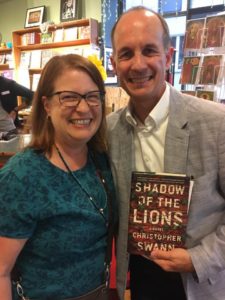
Afterward, I sat at a table by the cash register signing books. Some of my parents’ friends had dinner dates and dashed off, promising to get me to sign their copies later. One mom with her son who had just wandered into the store right before I read liked what she heard and so bought a copy. And then a woman stood before me, saying, “Well, hey, Swanny!” It was Martha, aka SmartyKate, an online friend I had never met before in person. Martha is one of the early members of the Fiction Files, a group launched on MySpace in the early 2000s by author Jonathan Evison. Johnny was just about to publish his first novel, All About Lulu, and the rest of the group consisted of avid readers and hopeful writers.* They had been my peer group, something I had missed after grad school. And now I was hugging Martha and signing a copy of my novel for her.
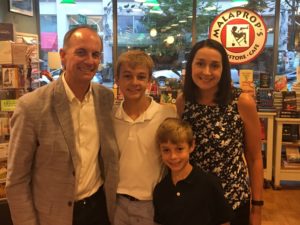
Then the line was gone and I stood up and stretched. Jacob came over, and I asked if the store had any copies they wanted me to sign. “We sold out,” he said.

My parents took our sons home with them so Kathy and I could go have a celebratory dinner. We found a local Italian place, Modesto. When we sat at our table, I put my copy of Shadow of the Lions face-down on the table. Kathy looked at me and then turned it face-up. A man and a woman dining next to us noticed. “My husband wrote a book,” Kathy told them, while I smiled and blushed and tried to look both proud and humble but probably just looked awkward. The woman took a picture of my book so she would remember it. The waitress was suitably impressed enough to offer us dessert on the house.

All in all, a great way to end the North Carolina leg of my tour.

*Johnny Evison has gone on to publish four novels–All About Lulu, West of Here, The Revised Fundamentals of Caregiving, and This is Your Life, Harriet Chance!–with a fifth in the works. He has been a mentor and a friend to me, and now we are both Algonquin authors. Other Fiction Filers include Ben Loory, author of Stories for Nighttime and Some for the Day and the upcoming Tales of Falling and Flying; Hugh Schulze, writer and director of the film CASS; and James P. Othmer, author of The Futurist, Adland, and Holy Water.

Filed Under: POSTS

Park Road Books in Charlotte, N.C.

August 20, 2017 by Christopher Swann

Park Road Books, located in a nice shopping center in Charlotte, looks relatively nondescript on the outside. Take a closer look through the large bay window–ignore the book on prominent display–and you’ll see something else. The front of the store has a small sitting area, almost like a casual living room with a fireplace. Behind that is the sales counter, and beyond that are the long, narrow alleys of bookshelves.
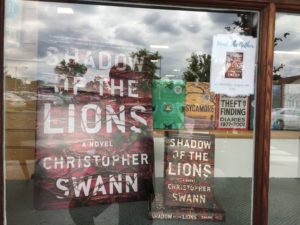
I met Sally, the manager, whose husband Frazer is in sales for Algonquin. She and her staff, particularly Chris and Shauna, were very friendly and helpful. While I was wandering the aisles, I heard at least two separate customers ask for book recommendations along the lines of, “I just read Gone Girl and liked it, and I’m looking for something similar, but not as dark, and maybe with more likable characters?” Each time, Park Road’s staff led the customer into the shelves, suggesting multiple books. This is the sort of thing indie bookstores do well. It’s not about the comfy chairs, or the whimsical decor, or the bran muffins they serve, or the hand-written notes from the staff about their favorite books. (Well, it might be about that last one, a little bit.) It’s about the personal connection with a customer, the deep knowledge of books and of readers, the memory not only for books but for those very customers when they return again and again, as many inevitably do. When I go into my neighborhood Barnes and Noble, the staff there are always very polite, but they might be selling books or belts or baklava. To those stores, a book tends to be a product. To a good indie bookstore, a book is, to quote Stephen King, a uniquely portable magic.

I was sort of wandering around in the store half an hour before my event was supposed to start when a vaguely familiar man and his teenage son approached.  “Chris Swann?” the man said. “I don’t know if you remember me. William Harris.” Mr. Harris was my ninth-grade Ancient History teacher at Woodberry. I had loved his class. He introduced me to his son, who had just graduated from Woodberry. They now lived in Charlotte, and had a prior dinner engagement, but he had wanted to stop by, get a copy of my book, and get my signature.
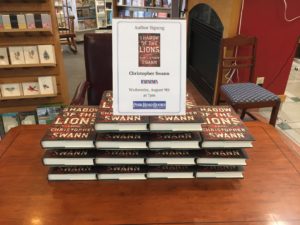
Mr. Harris and his son left, and then Trent and Mindy Merchant came in. Trent and I were classmates at Washington and Lee. Soon after graduation, I was coaching a soccer team at Holy Innocents’ and drove them up to a school in Rabun Gap for a game. The Rabun Gap coach turned out to be Trent. A few years later, we hired Trent to teach English, religion, and drama at Holy Innocents’. He also acted on stage, including at the Shakespeare Tavern in Atlanta. (One of my favorite Trent Merchant stories: he was acting onstage when an audience member began talking, loudly, which was distracting to both the other audience members and the actors. After a few moments, Trent called “Hold” to his fellow actors, essentially stopping the scene, then, addressing the audience member directly, told her to be quiet “or get the f— out.” That moment got written up in an article in the Atlanta Journal-Constitution.)

A confession: while I was truly glad to see Trent and Mindy, I was also a tad nervous. When I had read aloud from my novel before, I had read the first two or three pages as an introduction to the story. That night, I had decided to read the second half of the prologue, when Matthias and Fritz get into their argument, and Fritz takes off on his fateful run into the woods. It’s a more dramatic scene. It also contains dialogue, and so I wanted to read the two voices differently. I’m not a trained actor. Trent, on the other hand, is. I only hoped my reading would be satisfactory.

It was a small gathering that evening. Trent and Mindy sat in a row of chairs set out by the booksellers. Near them, an African-American lady sat by herself. A father and his teenage daughter sat on a couch to the side. Three women sat in comfy armchairs at the back. One of them, a regular customer, had driven all the way from Gastonia for tonight’s reading.

There was a table at the front of the reading space where presumably I would sign books afterwards. A large armchair sat behind the table. When it was time for me to start, I pulled the chair out from behind the table and sat closer to the audience. “Feels less like a board meeting,” I said. They chuckled appreciatively. Trent sat back in his chair, comfortable, expectant.

Different bookstores, I’ve found, have different perspectives on authors reading from their works. Some love it. Others actively dissuade authors from doing it, fearing it will be boring. I’ve attended fantastic author readings. I’ve also attended some that were less exciting than watching students take the SAT.

Because I’ve taught for a while now, at certain points in certain units I’m pretty confident about what I’m about to do or say in class. It’s not cockiness or arrogance, just a simple sense that I know what I’m about to do, and I know I am capable of doing it well. I can feel that confidence settle on me, like a mantle. And that’s how I felt when I started reading that passage.

It’s not foolproof, that feeling. I’ve been wrong before, realizing that I’m losing my audience. I glanced up from my book occasionally to see how the audience was reacting. The father and daughter were watching me carefully. The lady from Gastonia had closed her eyes, but it seemed she was doing it to better focus on hearing me read aloud; she was nodding her head and smiling occasionally. Trent was now leaning forward in his chair, as if to hear me better. Once or twice he, too, closed his eyes.

When I got to the end, where Matthias admits his twinned sense of guilt and jealousy, his anger that Fritz had left him behind, I concluded, somewhat lamely, “And that’s the prologue.” The audience paused for a moment, then clapped. It was quiet applause, but it was earnest. Trent was grinning.

Read that part from now on, I thought.

Next stop – Malaprop’s in Asheville!

Filed Under: POSTS

  • « Go to Previous Page
  • Page 1
  • Page 2
  • Page 3
  • Page 4
  • Page 5
  • Go to Next Page »

Footer

Newsletter

WEBSITE DESIGN HELP

JENNY CORNETET

  Follow Me

  Facebook     Bluesky     Instagram     TikTok     Substack

Copyright © 2026 · Author Pro on Genesis Framework · WordPress · Log in